

Inflation forecast : an energy shock set to persist
- The energy shock is expected to persist
The conflict between the United States and Iran is disrupting energy prices worldwide. Markets expect prices to remain high for a prolonged period. - Inflation in the euro area is expected to remain high for longer than anticipated
Driven by rising energy prices, inflation in the euro area would not return towards 2% until 2028, compared with a return anticipated in 2027 in the spring forecasts. - In Luxembourg, the extension of energy support measures should contain inflation
The extension of the Resilienzpak (discounts on motor fuels, heating oil, electricity and gas) would continue to mitigate the rise in energy prices. Under the central scenario, inflation would stabilise at 2.5% in 2027 and 2028. However, alternative scenarios show a high degree of uncertainty, with inflation potentially ranging between 2.0% and 3.0% depending on energy price developments over the forecast horizon. - Wage indexation would depend on price developments
The next wage indexation would be expected in the second quarter of 2027, followed by another in the second quarter of 2028. These dates could be brought forward or pushed back depending on pressures on energy prices.
The conflict between the United States and Iran, ongoing since March 2026, is continuing. The Strait of Hormuz remains almost closed to shipping, Brent averaged USD 106 per barrel in October, and markets now expect energy prices to remain high for an extended period. The inflationary shock, which the spring assumptions had confined to 2026, would thus extend into 2027: inflation in the euro area would not return towards 2% until 2028.
In Luxembourg, inflation stands at 2.7% in October. According to STATEC's forecasts, which incorporate the energy support measures (Resilienzpak) extended on 29 October, it would average 2.3% in 2026, then 2.5% in both 2027 and 2028. The next wage indexation would take place in the second quarter of 2027, followed by another in the second quarter of 2028. This timetable remains sensitive to energy prices: further pressures would bring these dates forward by one quarter, while a sustained decline would postpone the second.
Annual inflation rate and contributions

Source: STATEC (forecasts as of 04/11/2026)
In the Middle East, no end to the crisis in sight
The respite in June, when the memorandum of understanding between the United States and Iran had allowed traffic to resume through the Strait of Hormuz, lasted only a few weeks. Since the renewed closure in late July, shipping has been almost at a standstill: in October, barely three vessels per day were still passing through the strait (according to IMF data), compared with nearly one hundred on average in 2025.
With part of global supply cut off, energy markets have tightened again. Having fallen back to around USD 85 per barrel in June and July, Brent rose again from August to average USD 106 in October. The price of European gas has risen more steadily and with less volatility than Brent, but the TTF spot price now stands at around EUR 85/MWh, its highest level of the year and more than double its January level. These increases are compounded by pressures on oil transport and refining: tanker freight costs have more than doubled since January, and refining margins for certain distillates have almost quadrupled, making diesel and heating oil particularly more expensive.
The shock is no longer seen as temporary: in the spring, markets expected prices to fall back rapidly; they are now pricing it into the years ahead. Brent futures for 2027 exceeded USD 90 in October, compared with around USD 63 in January, while those for 2028 are close to USD 80. The shift is even more pronounced for gas: contracts for 2027 are trading at around EUR 67/MWh, or about 2.5 times their January level. These expectations remain fragile, however: a change in the course of the conflict, just like a further escalation, could shift them within days, in either direction, as June and then late July showed.
In the euro area, inflation more persistent than expected
Oxford Economics' international assumptions, updated in mid-October and adopted by STATEC, reflect this change in outlook. In the spring, the central scenario assumed a short-lived shock: after peaking in the second quarter of 2026, Brent was expected to return towards USD 70 as early as 2027. It is now expected to average USD 98 in 2026 and still USD 96 in 2027, before gradually falling back in 2028 (USD 73).
The inflation profile in the euro area is therefore shifted further into the future. Driven by energy (+18.9% year on year), it has already risen from 3.2% in August to 3.8% in September. Whereas the assumptions used during the spring tripartite discussions envisaged a return to 2% as early as 2027, inflation would reach 3.0% in 2026, remain at 2.7% in 2027 and not return towards 2% until 2028 (1.8%). The pass-through to other prices would also occur later: food inflation, which remained moderate in 2026 (1.8%), would accelerate in 2027 (2.9%), and core inflation would reach 2.7% that same year.
Oxford Economics is not alone in revising its forecasts upwards for the euro area. In September, the ECB raised its forecast for 2027 by 0.2 percentage points to 2.5%, before a return to 2.1% in 2028; its alternative scenarios, which put 2027 inflation between 1.9% and 5.4%, illustrate the uncertainty surrounding these projections1. The OECD raised its 2027 forecast from 2.1% to 2.9% in September, and in October the IMF anticipates inflation of 3.1% in 2026 and 2.8% in 2027. The European Commission, which had forecast inflation of 3.0% in 2026 in the spring, will publish its autumn forecasts during the month.
[1] STATEC's high scenario is comparable in magnitude to the ECB's adverse scenario (3.2% in the euro area in 2027); the ECB's severe scenario assumes a much larger shock. Furthermore, STATEC's scenarios are not symmetrical (the low scenario only diverges from the central scenario from the second quarter of 2027 onwards), and the support measures, set as fixed amounts per unit, cushion part of the shock in Luxembourg.
In Luxembourg, an increase still concentrated in energy
In Luxembourg, inflation stands at 2.7% in October, after 2.9% in September. Its pattern mirrors that of oil prices: having exceeded 3% in April, at the height of the first closure of the strait, it had returned to around 2.2% over the summer, before rebounding as Brent rose again. Energy remains its main driver: it alone accounts for around one percentage point of October inflation.
The Resilienzpak support measures have only partially cushioned this increase. Despite the EUR 0.15/l discount in effect since August, heating oil still cost EUR 1.39/l in October, 68% more than in January (EUR 0.83/l), just as the heating season begins. Without the discount, it would reach EUR 1.54/l, or 87% more than in January, exceeding the April peak (EUR 1.47/l). At these levels, the 15 cents now represent only around one-tenth of the price paid by households. Diesel follows the same trend: despite the EUR 0.05/l reduction, it cost an average of EUR 2.05/l in October, 47% more than in January (51% excluding the discount).
The pass-through to other prices remains limited at this stage. Excluding energy, inflation remains below 2% in October. Food inflation, which reached 3% at the beginning of the year, has returned to around 1.5%, and non-energy industrial goods prices are rising only slightly. Services contributed to the September peak, notably due to highly volatile prices such as those of childcare centres and passenger air transport, the latter potentially also reflecting in part the rise in the price of jet fuel. To date, the indirect repercussions linked to fertiliser or transport costs do not appear to have generated significant second-round effects.
Extended energy support measures, an effect deferred over time
To cushion the shock, the government and social partners adopted a set of measures under the name Resilienzpak in June, following the tripartite discussions. Since the summer, these have reduced energy prices including VAT by EUR 0.05/l for diesel and petrol (since July), as well as by EUR 0.15/l for heating oil, EUR 0.04/kWh for electricity and EUR 0.15/m³ for gas (since August). These measures have lowered inflation by 0.7 percentage points since August (equivalent to 0.3 percentage points on average in 2026).
Initially, the support measures were due to end on 31 December 2026. Their removal would have mechanically raised the price level in January 2027. On 29 October 2026, the Tripartite Monitoring Committee decided to extend support for electricity, gas and heating oil until 31 December 2027. Support for diesel and petrol has been extended until the end of February 2027.
This extension reduces inflation in 2027 by nearly 0.7 percentage points, only marginally shifting the triggering of the wage indexation expected in the second quarter of 2027, but preventing a second adjustment from being granted in the same year. However, it merely postpones the effect of the withdrawal of the measures: the end of fuel support will raise the price level in March 2027, and the end of the other support measures in January 2028, adding around 0.7 percentage points to inflation in 2028. Over 2026–2028, cumulative inflation is virtually unchanged.
Summary of inflation forecasts
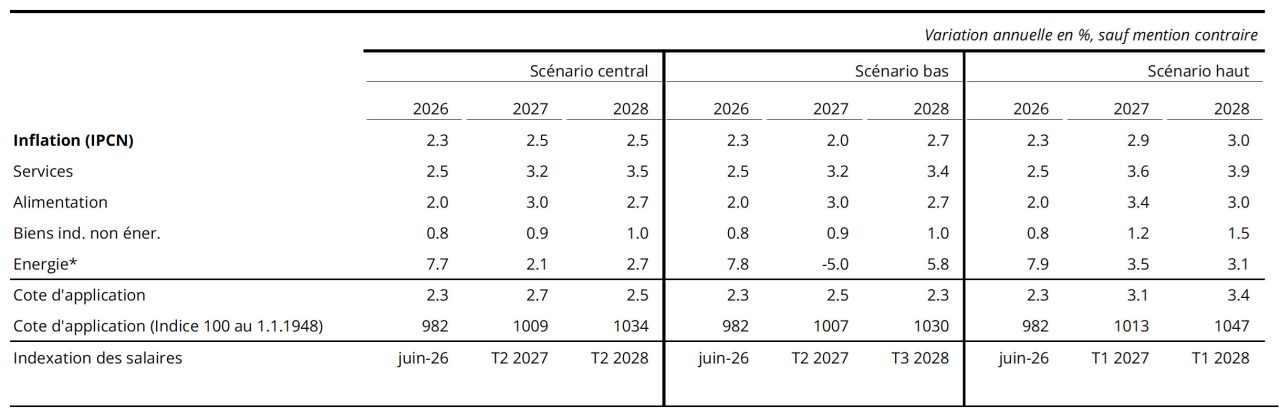
Source: STATEC (forecasts dated 04/11/2026)
* These forecasts assume, as a technical assumption of unchanged policy, an increase in the CO2 tax of EUR 5/tCO2e in 2027 and 2028. This increase raises inflation as measured by the national consumer price index (IPCN), but its direct effect is neutralised in the calculation of the six-month average that determines the applicable index level: it therefore has no impact on the timetable for wage indexation presented here.
Inflation expected to remain above 2% through 2028
In the central scenario, inflation would stand at 2.5% in both 2027 and 2028. Without the extension of the support measures decided on 29 October, it would be around 3.1% in 2027 and 1.9% in 2028: the stability at 2.5% over these two years is therefore largely the result of this decision, which defers part of the price increase to 2028. The composition of inflation would also change: driven by energy in 2026, inflation would subsequently be supported mainly by the other components.
In 2026, energy prices would rise by 7.7%, driven by the surge in oil product prices (+15.7%). Their contribution would then decline markedly: energy inflation would fall back to 2.1% in 2027 – reflecting the extension of support measures and lower electricity prices, while oil prices remained high – before rising again to 2.7% in 2028 with the end of support for electricity, gas and heating oil. Trends would nevertheless differ across energy sources. The price of gas for households would increase by around 10% in 2027 (from EUR 0.92 to EUR 1.01/m³), due to higher market prices, despite the continuation of the EUR 0.15/m³ support. Conversely, the price of electricity would fall by around 9% (from EUR 0.24 to EUR 0.22/kWh), with the EUR 0.04/kWh support applying throughout the year, compared with five months in 2026, before rising again in 2028 (EUR 0.26/kWh) with the end of the support measures. Services would take over, with inflation rising from 2.5% in 2026 to 3.2% in 2027 and 3.5% in 2028, along with food (3.0% in 2027, then 2.7% in 2028), as higher energy and input costs were passed through to prices. Inflation for non-energy industrial goods would remain moderate, at around 1%.
Within the year, however, the pattern would be uneven. Inflation would exceed 3% in January and February 2027 (3.5% and 3.4% respectively), a base effect unrelated to the support measures: energy prices would be compared with those at the beginning of 2026, before the conflict, when their contribution to inflation was strongly negative. This effect would fade as early as spring, with inflation temporarily returning towards 1.7% in April, compared with the peak in April 2026. According to these forecasts, the next wage indexation would take place in the second quarter of 2027, followed by another in the second quarter of 2028.
Alternative scenarios to frame the uncertainty
Given the high degree of uncertainty, this central scenario is supplemented by two alternative scenarios. They do not define a probability interval, but illustrate the range of possible trajectories. For 2026, ten months of which are already known, all converge towards 2.3%; however, they diverge significantly from 2027 onwards.
In the high scenario, which assumes a lasting disruption to energy flows, Brent would remain at around USD 104 per barrel in 2027, before falling back to USD 82 in 2028. The shock would spread more broadly to the rest of the economy: services inflation would reach 3.6% in 2027 and food inflation 3.4%. Overall inflation would rise to 2.9% in 2027 and 3.0% in 2028, and the wage indexation would be brought forward to the first quarter of 2027 and then the first quarter of 2028.
The low scenario, by contrast, assumes a rapid normalisation of energy markets. It follows the central scenario until the first quarter of 2027, then assumes a fall in prices as rapid as the one following the memorandum of understanding between the United States and Iran in June: Brent would return to an average of USD 75 per barrel in 2027, then USD 60 in 2028. Energy prices would fall by 5.0% in 2027 and overall inflation would stand at 2.0%. It would, however, rise again to 2.7% in 2028, above the central scenario: the withdrawal of support measures would push up energy prices (+5.8%) even as market prices continued to fall, while services and food would maintain trends close to those of the central scenario. The adjustment in the second quarter of 2027 would remain unchanged, while the next would be postponed to the third quarter of 2028.
Overall, inflation would range between 2.0% and 2.9% in 2027 depending on the scenario, and between 2.5% and 3.0% in 2028. Under all the scenarios considered, a wage indexation would occur in the first half of 2027. Recent months nevertheless show how quickly the situation can change, and an even more prolonged disruption than in the high scenario cannot be ruled out. In addition, there are climate-related uncertainties, of a different nature from those captured by the scenarios: the severity of the winter, which determines demand for gas and therefore its price, and global weather conditions, which affect harvests and feed through to food prices with a lag of several quarters.
Summary of consumer price forecasts* for the main energy products
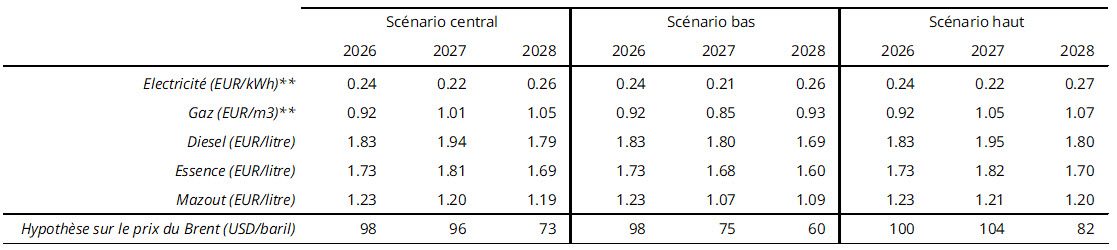
Source: STATEC (forecasts dated 04/11/2026)
* These forecasts assume, as a technical assumption of unchanged policy, an increase in the CO2 tax of EUR 5/tCO2e in 2027 and 2028. This increase raises inflation as measured by the national consumer price index (IPCN), but its direct effect is neutralised in the calculation of the six-month average that determines the applicable index level: it therefore has no impact on the timetable for index-linked adjustments presented here.
** Average prices including VAT for a residential customer in Luxembourg with annual consumption of 2,426 m³ of gas and 3,901 kWh of electricity.

Press office| Tél 247-88455 | press@statec.etat.lu
This publication was produced by Jill Schaul and Gabriel Gomes.
STATEC would like to thank all contributors who helped make this publication possible.
The total or partial reproduction of this publication is authorised provided that the source is acknowledged.
Last update