

Lower migration, low fertility: the demographic slowdown continues

On 1 January 2026, the Grand Duchy of Luxembourg had a population of 690,959, an increase of 1.3% compared with1January 2025. This growth rate is lower than that observed a year earlier (1.5%), but also significantly lower than during the last decade (when it ranged from 2.0 to 2.5%) or even during the COVID-19 period (1.4 and 1.7% for 2020 and 2021).
This population increase is mainly due to migration: 24,985 migrants arrived in the country in 2025 and 17,141 left.
In 2025, 6,439 babies were born. This is 0.3% fewer than in 2024. The total fertility rate stands at 1.23 children per woman (compared with 1.25 in 2023 and 2024) and has never been so low.
In 2025, 4,396 people died, 1.7% fewer than in 2024. Life expectancy at birth is 85.2 years for women and 81.1 years for men.
During 2025, the natural increase (births minus deaths) was 2,043 people, whilst the net migration (arrivals minus departures) was 7,844 people.
[1] Figures based on the Naional Register Persons. Please note that there is also a statistical adjustment of -901, consisting of a computer clean-up of the National Register of NAtural Persons.
As of 1 January 2026, the average age of the population is 40.8 years for women and 39.5 years for men. Foreign residents are significantly younger than Luxembourg nationals. The average age for Luxembourgish women is 42.2 years, compared with 39.3 years for foreign women. The difference is less pronounced for men, with the average age standing at 40.0 years for Luxembourgish men compared with 38.9 years for foreign men.
Low fertility
The number of births recorded in 2025 is slightly lower than in 2024: 6,439 births in 2025 compared with 6,459 births in 2024 (-0.3%). This slight fall in the number of births, combined with population growth, means that the total fertility rate[1] falls compared with 2023 and 2024, standing at 1.23 children per woman in 2025. Since the early 2000s, Luxembourg has seen a decline in its fertility rate.
This decline is also observed in other European countries. For example, within the EU-27, the total fertility rate fell from 1.43 children per woman to 1.34 children per woman between 2001 and 2024.
Figure 1: The fertility of foreign women is higher than that of luxembourgish women despite a common downward trend

Source: STATEC
NB: Data for 2009 are not available
The fertility rate among Luxembourgish women is extremely low and is approaching the replacement level of one child per woman (1.16 children per woman in 2025). This indicator is also falling for foreign women, although their fertility rate (1.35 children per woman) is higher than that of Luxembourgish women. Compared to 2024, the fertility rate among Luxembourgish women has stabilised, or even increased slightly (+0.04 children per woman), whilst that of foreign women has continued to fall (-0.06 children per woman).
Life expectancy remains high
In 2025, the number of deaths stood at 4,396. This figure is slightly lower than in 2024 (4,471 deaths), whilst the population increased by 1.3% over the same period. Among the deaths in 2025, there were slightly more male deaths (50.7%) than female deaths (49.3%). The population of Luxembourgish nationality alone accounts for 75.1% of deaths, whilst deaths among foreign nationals are much rarer (24.9%, or 1,095 deaths). This difference is largely explained by the age structure of the population, which is younger among foreign nationals.
The[2] mortality rate, which had risen during the COVID-19 period (7.3‰ in 2020 and 7.0‰ in 2021), continues to fall and stands at 6.4‰ in 2025 (6.6‰ in 2024), meaning that 6.4 deaths are recorded per 1,000 inhabitants.
The average age of all deaths is 78.1 years, 81.1 years for women and 75.1 years for men. Life expectancy at birth falls slightly compared with 2023[3] and stands at 85.2 years for women and 81.1 years for men. The gap between women and men narrows, falling from 7.2 years in 1973 to 4.1 years in 2024.
Figure 2: Rising life expectancy, particularly for men

Source : STATEC
Immigration on the decline
In 2025, Luxembourg recorded 24,985 arrivals (-2.9% compared to 2024) and 17,141 international departures (+4.2%). The net migration figure, i.e. the difference between immigrants and emigrants, stands at 7,844 people.
In 2025, French nationals were the largest group to settle in Luxembourg (3,515 immigrants), ahead of Portuguese nationals (3,147 immigrants) and Luxembourg nationals (2,204 immigrants).
Among emigrants, i.e. people leaving Luxembourg for another country, the top three are as follows: Luxembourgers (3,315 emigrants), Portuguese (2,898 emigrants) and French (2,504 emigrants).
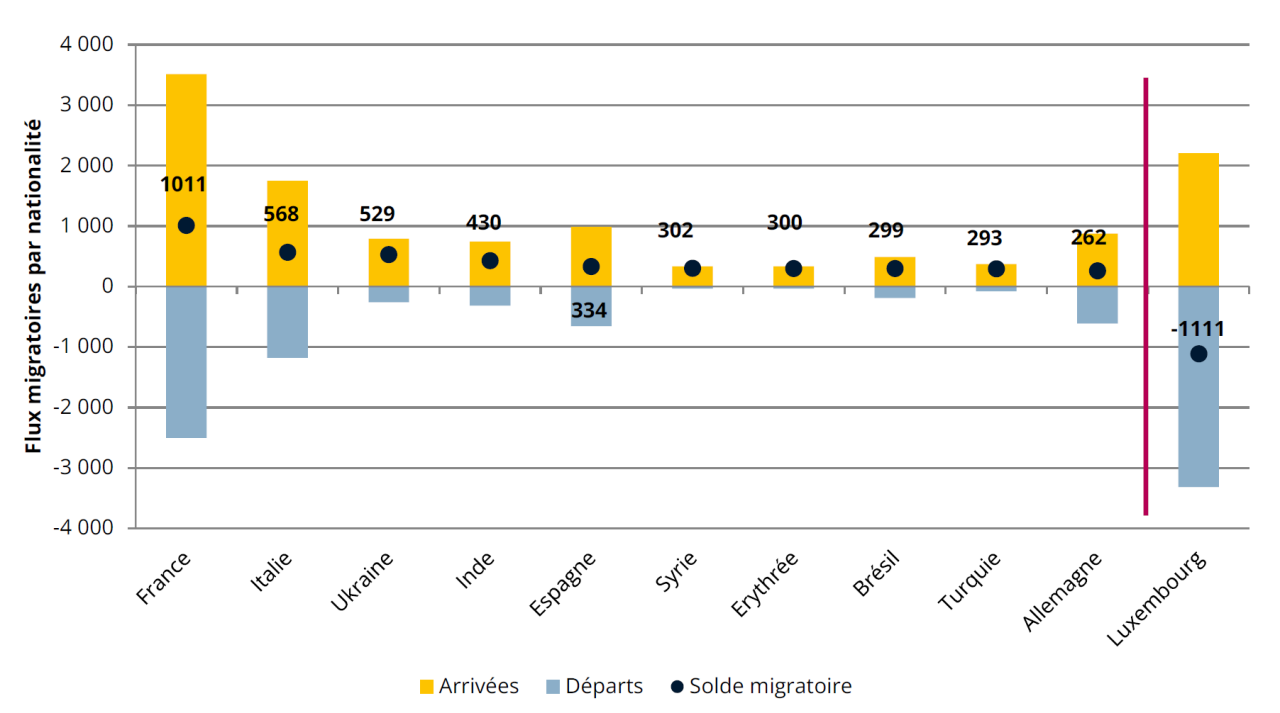
As for the net migration balance (the difference between immigrants and emigrants), the diversity of migration is more pronounced. The French lead the way. They are followed by Italians and Ukrainians. The top 10 is rounded off by Indians, Spaniards, Syrians, Eritreans, Brazilians, Turks and Germans.
As for Luxembourgers, increasing numbers are leaving the country, resulting in a negative net migration of -1,111 (-1,516 in 2024): 2,204 Luxembourger immigrants compared with 3,315 Luxembourger emigrants.
Figure 3: Of the 10 foreign nationalities most widely represented in the net migration figures for 2025, only four are from the european Union
Sources: STATEC based on the RNPP
The proportion of Luxembourgers on the rise
As of 1January 2026, 322,050 foreign nationals live in the Grand Duchy, 11.8% of whom were born in Luxembourg. As Luxembourg’s demographic growth is driven by migration, the proportion of foreign nationals in the population is therefore significant (46.6%) but has fallen compared with last year (47.0%). This slight decrease in the proportion of foreign nationals is due to lower immigration, naturalisations and the various legislative implications arising from these: for example, foreign minors with a parent who has acquired Luxembourgish nationality may be naturalised.
Some 180 nationalities are present in Luxembourg as of 1January 2026. Among the ten foreign nationalities with the highest number of nationals, eight are from the EU-27. The first non-EU community in this top 10 is made up of Ukrainian nationals, with a total of 6,028 people. The second-largest non-European community is made up of Indian nationals, numbering 5,728.
Although their numbers have been declining in recent years, Portuguese nationals remain the largest foreign community, accounting for 12.8% of the total population. They are followed by the French (7.1%) and the Italians (3.7%). These three foreign communities make up just over half (50.6%) of the foreign population. Next come the Belgians (2.6%) and the Germans (1.8%).
There are 242,682 foreign nationals holding EU-27 citizenship. They account for 75.4% of the foreign resident population. Next, in order of size, come nationals from non-EU European countries, accounting for 7.5% (24,058 people), those from Asian countries (24,010 people and 7.5% of the foreign population), Africa (6.5% and 20,912 people), the Caribbean, North, South or Central America (3.1% and 9,847 people) and Oceania (273 people). Finally, 268 stateless persons or those of unknown nationality should be added to these figures.
Figure 4: A highly cosmopolitan population

Sources: STATEC, CTIE
It should be noted that, in 2026, 26.7% of Luxembourgers (compared with 24.7% on1January 2025) hold a second nationality. Among these Luxembourg nationals, 24.7% hold Portuguese nationality as their second nationality, 14.1% hold French nationality and 7.0% hold Italian nationality.
Acquisitions of Luxembourgish nationality up by 10.9% compared to 2024
During 2025, a total of 8,223 people (residents and non-residents) obtained Luxembourgish nationality following naturalisation, option and recovery procedures. This figure represents an increase of 10.9% compared to 2024 (7,415 naturalisations).
It was mainly through the option procedure that many people were able to acquire Luxembourgish nationality in 2025:
- 6,544 people obtained Luxembourgish nationality through the option process. This option is available, for example, to people who have been legally resident in Luxembourg for 20 years, have completed at least 7 years of schooling there, or are over 12 years of age and were born on Luxembourgish territory;
- 1,298 people obtained Luxembourgish nationality through naturalisation;
- 381 people acquired Luxembourgish nationality by restoration, which allows adults to regain their nationality after having lost it, subject to certain conditions.
Of these cases of acquisition of Luxembourgish nationality, 26.6% were granted to people not resident in Luxembourg (20.5% in 2024). Among these individuals, there were 906 Brazilian nationals (41.4% of non-residents), 596 Americans (27.2% of non-residents) and 292 French nationals (13.3% of non-residents).
Chart 5: Since 2009 (the law on dual nationality), 38.4% of acquisitions of Luxembourgish nationality have involved non-residents

Source: Ministry of Justice, STATEC
Among residents, the highest numbers of acquisitions were among Portuguese nationals (1,153 people, or 19.1% of residents), French nationals (798 people, or 13.2% of residents) and Italian nationals (316 people, or 5.2% of residents).
Increase in marriages and divorces
In 2025, the rise in marriages observed in 2023 and 2024 continued. Indeed, 2,604 marriages were celebrated (+1.4% compared to 2024). Of these unions, 89 were between two people of the same sex, including 56 between men and 33 between women. The average age at first marriage is 33.2 years for women and 34.7 years for men.
In 2025, the number of divorces granted by the courts stood at 1,367, an increase of 14.2% compared to the previous year. The average duration of marriages dissolved in 2025 was 12.8 years.
[1] The total fertility rate is also known as the "sum of reduced births": it represents the final number of descendants in a hypothetical generation that would, at each successive age, have the fertility rates taken from each of the thirty-five actual generations (aged 15 to 49) observed during a given year. The figures are estimates. The total fertility rate for resident women has been calculated using the fertility rate by age group.
[2] Ratio of the number of deaths in the year to the average total population for the year.
[3] Life expectancy is calculated over a three-year period, in this case 2023 to 2025 (central period: 2024), in order to mitigate sharp annual fluctuations (such as a health crisis or an accident involving many people), which would significantly affect life expectancy by age.
Press office
| Tél 247-88455 | press@statec.etat.lu
This publication was produced by the Population and Housing’ unit. STATEC would like to thank all those who contributed to the production of this publication.
The reproduction of this newsletter, in whole or in part, is permitted provided that the source is acknowledged.
Last update