

Other languages
Regards_Emploi_29072021

13-21-Les internautes résidents préoccupés par leur sécurité et protection en ligne
12-21_Regards_tourisme_proximité

11-21 Regards_mortalité_2020_V1-1

290421-regards-commerce-electronique
Regards-temps-trajet-21042021

N° 07/2021 - Un été pas comme les autres...
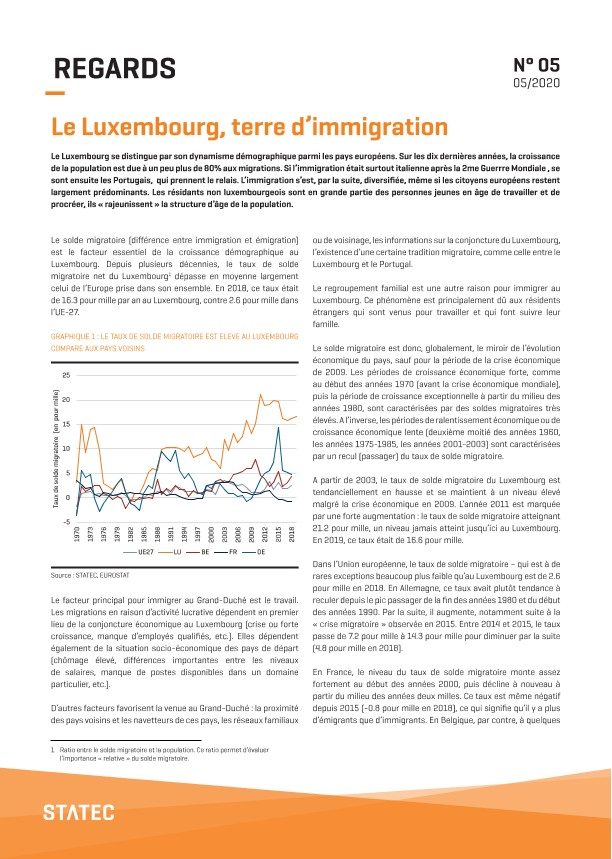
N° 05/2020 - Le Luxembourg, terre d’immigration
Luxembourg stands out for its demographic dynamism among European countries. Over the last ten years, population growth has been due to a little over 80% to migration. In 2019, the French will account for 14.8% of migrants. Next come the Italians and the Portuguese, with 9.2% and 8.9% of migrants respectively. 72.2% of immigrants are aged between 18 and 50. The majority of them come to Luxembourg to work or live with their families.
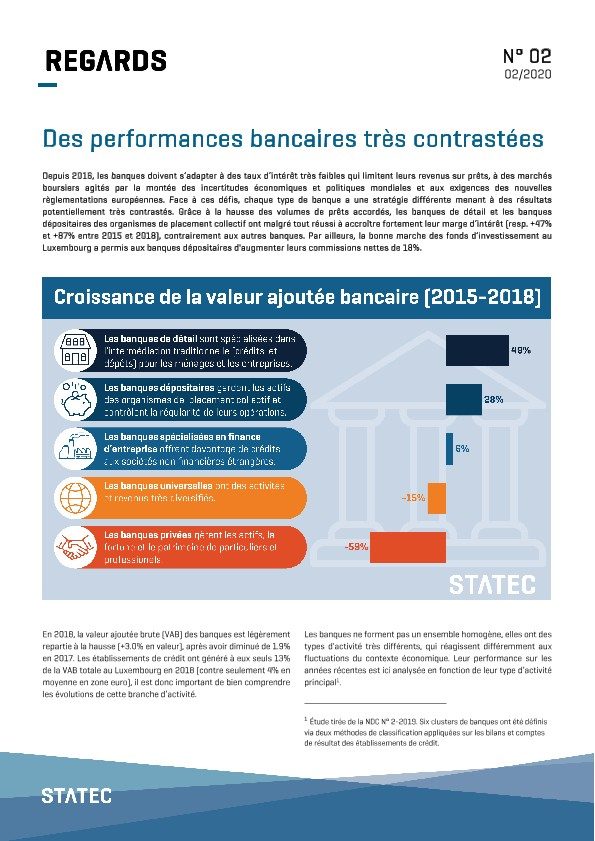
N° 02/2020 - Des performances bancaires très contrastées
Since 2016, banks have to adapt themselves to very low interest rates that limit their income from loans, to stock markets agitated by rising global economic and political uncertainties and to the requirements of new European regulations. Faced with these challenges, each type of bank has a different strategy leading to very contrasting results. Thanks to the increase in granted loan volumes, the retail banks and the depositaries of collective investment schemes have managed, unlike other banks, to increase significantly their interest margin (resp. + 47% and + 87% between 2015 and 2018). In addition, the good performance of investment funds in Luxembourg has enabled depositary banks to increase their net commissions by 18%.
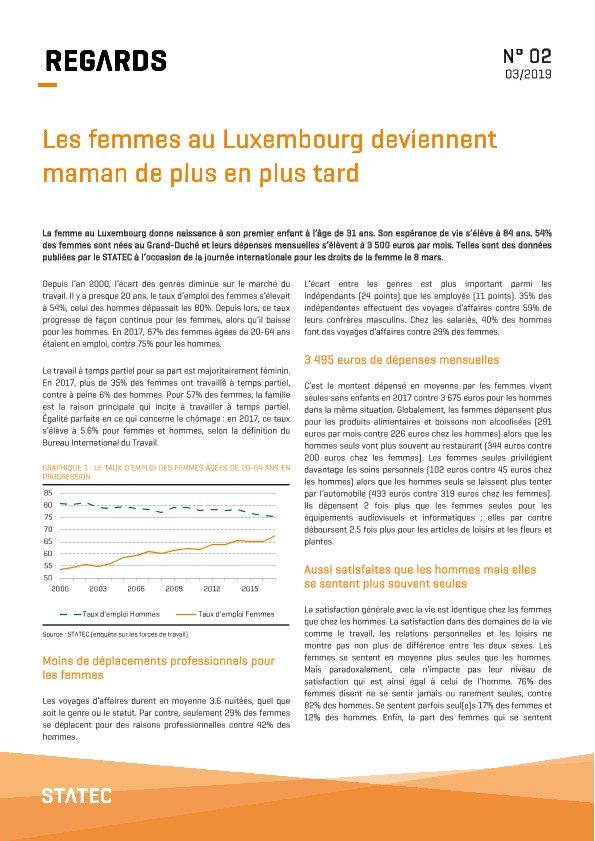
N° 02/2019 - Les femmes au Luxembourg deviennent maman de plus en plus tard
Women in Luxembourg give birth to their first child at the age of 31. Their life expectancy is 84 years. 54% of the women were born in the Grand Duchy and their monthly expenses amount to 3,500 euros per month. These are data published by STATEC on the occasion of the International Day for Women's Rights on 8 March.
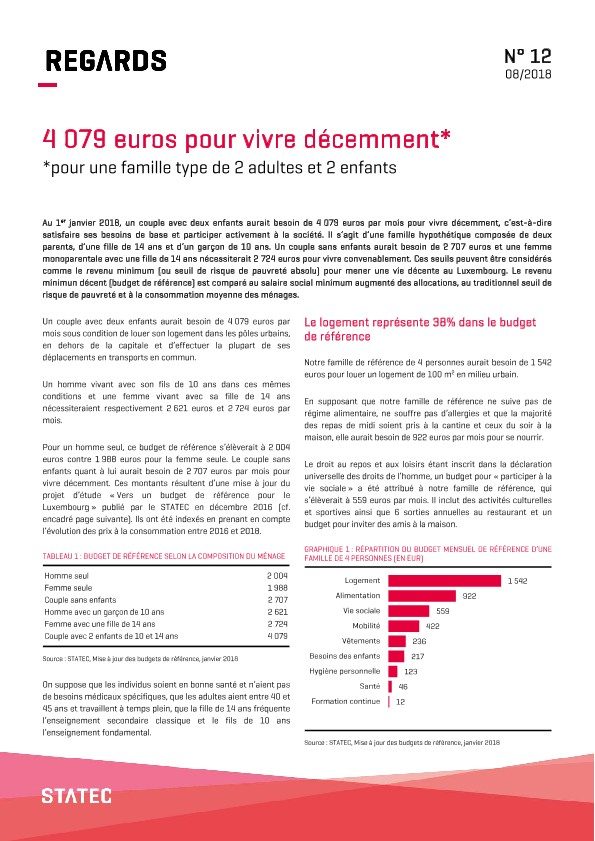
Regards 12-18: 4 079 euros pour vivre décemment
As of January 1, 2018, a couple with two children would need 4,079 euros per month to live decently, that is, to meet basic needs and participate actively in society. This is a hypothetical family consisting of two parents, a 14-year-old girl and a 10-year-old boy. A couple without children would need 2,707 euros and a single mother with a 14 year old girl would need 2,724 euros to live conveniently.

Regards 11-18 Pourquoi la valeur ajoutée du secteur financier ne repart-elle pas à la hausse?
Although bank revenues have increased, their efforts to modernize and adapt to new regulations have increased their costs. However, the solvency indicators of the main Luxembourg banks remain very well oriented and financial sector results are better than in the euro zone in terms of value and employment.
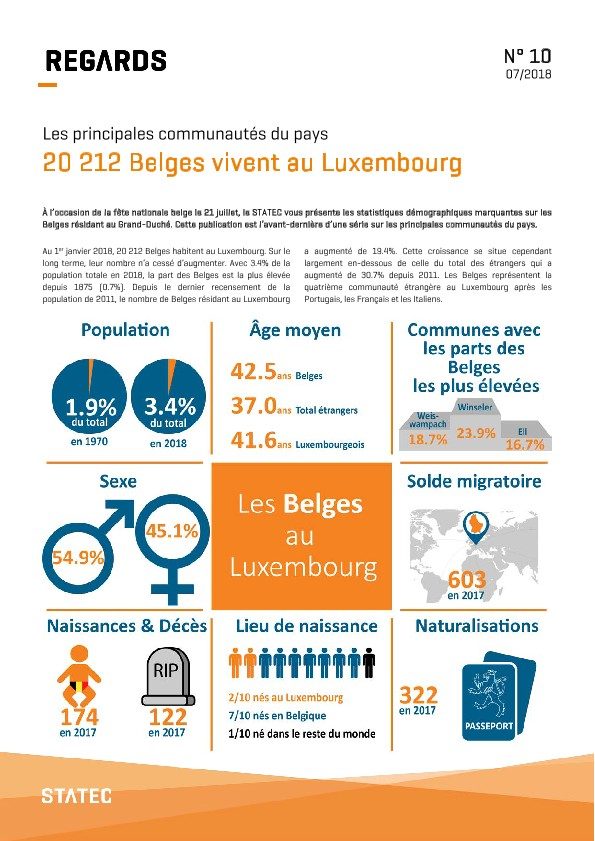
Regards 10-18 Les Belges au Luxembourg
On the occasion of the Belgian national holiday on July 21st, STATEC presents some statistics on Belgians in the Grand Duchy.
They represent 3.4% of the total population. Belgians are most present in the communes located on the border of Belgium, like Winseler, Weiswampach or Ell. The number of Belgians applying for and obtaining Luxembourgish nationality fluctuates over time and is 322 in 2017 (6.5%).

Regards 08-18 Croissance pro pauvres ou pro-riches?
Over the 2003-2015 period, the wealthiest households benefited more from the fruits of economic growth. The growth was therefore pro-rich! STATEC's analysis also shows that inequality cannot be summarised by the usual indices of inequality or risk of poverty, because they are too global.

Regards 07-18 Les Luxembourgeois au Luxembourg
They represent 52.1% of the total population. The share of Luxembourgers varies between 29.2% in the municipality of Luxembourg and 79.6% in Wahl. The effect of the law on Luxembourg nationality is not fading: the number of voluntary acquisitions has increased from 4,022 in 2009 to 9,030 in 2017.
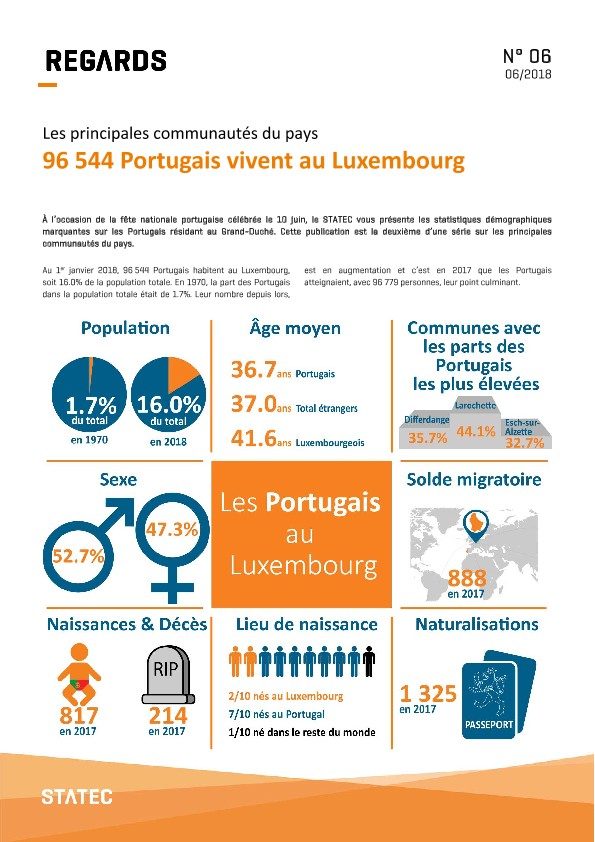
Regards 05-18 Les Portugais au Luxembourg
They represent 16% of the total population. In Larochette nearly one inhabitant in two is Portuguese. In absolute terms, it is in Luxembourg City that the Portuguese are the most numerous. On the occasion of the Portuguese National Day on June 10, STATEC presents some statistics on the Portuguese in the Grand Duchy.
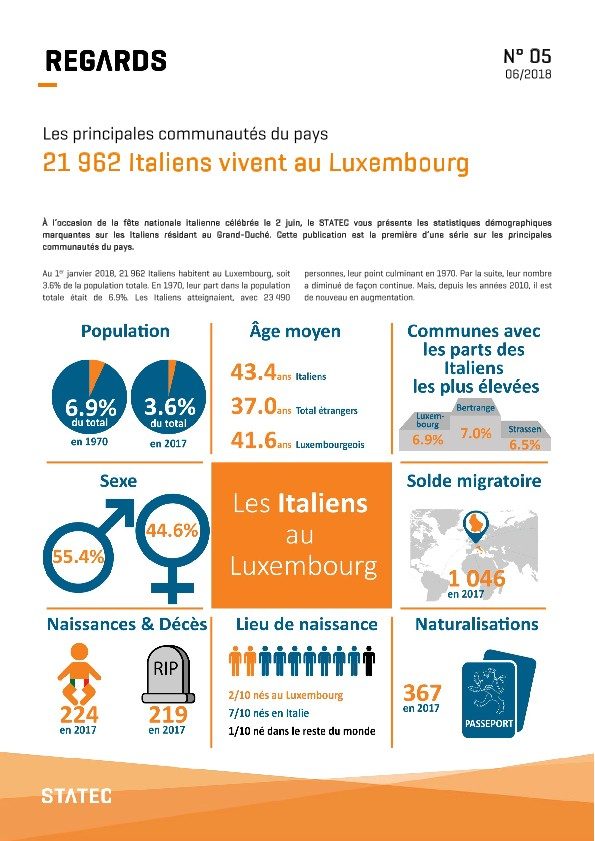
Regards 05-18 Les Italiens au Luxembourg
The share of Italians in the population is highest in Bertrange and Luxembourg-Ville. The number of Italians obtaining Luxembourg nationality has decreased significantly since 2010, from 663 acquisitions (15.8% of the total) to 367 in 2017 (7.4%). On the occasion of the Italian National Day on June 2nd, the STATEC presents some statistics on the Italians living in the Grand Duchy.

Regards 04-18 Formation dans les entreprises
Luxembourg is making progress with regard to the percentage of companies offering training, but remains in 10th place in the European Union. Nevertheless, the impact of these training courses is very important: more employees participate in continuing vocational training courses and spend more hours there than in most other EU countries. In Luxembourg, the percentage of women participating in training is higher than that of men, whereas the opposite is the case in most Member States.

Regards 03-18 La satisfaction au cours de la vie au Luxembourg dépend-elle de l’âge ?
In 2016, the level of life satisfaction Luxembourg has an average of 7.5 on a scale of 0 to 10. The surveyed adults reported an average score of 6.8 for the satisfaction of the time spent in activities they enjoy and a score 5.7 for trust in others. Residents aged 16-29 and 65-74 are the most satisfied with their lives. And among those aged 35-64, income is one of the main factors.

02-18 Regards sur les taux d’intérêt
Since 2009, interest rates in the euro zone are very low and put pressure on the banks' revenues. Most Luxembourgish banks were affected by a decrease in their interest margin. However, more recently, this decline has been partly offset by higher credit volume and lower charges.
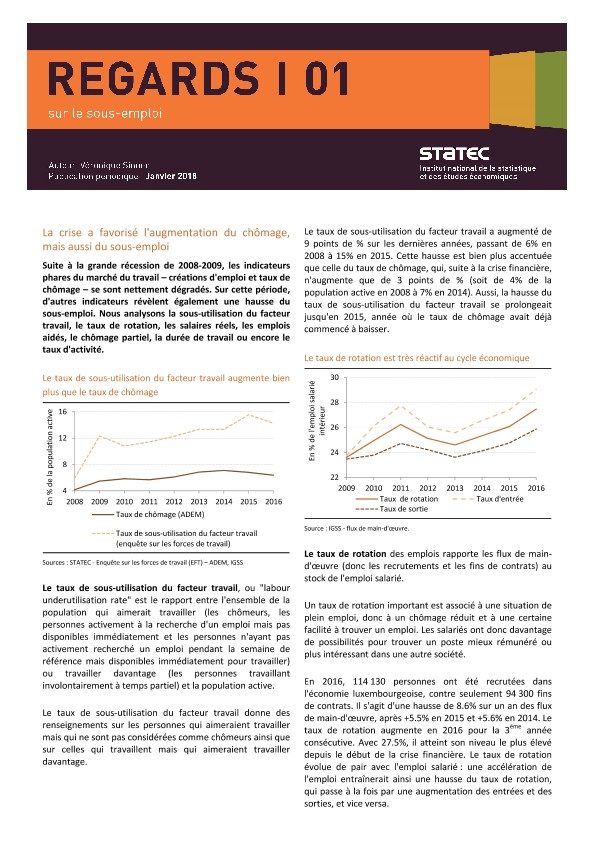
01-18 Regards sur le sous-emploi
Following the Great Recession of 2008-2009, the main indicators of the labour market - job creation and unemployment rate - have deteriorated significantly. Over this period, other indicators also reveal an increase in underemployment. We analyse the underutilisation of the labour factor, turnover rate, real wages, subsidised jobs, partial unemployment, working time or activity rate.

17-17 Regards sur les activités en ligne des particuliers
Activities on the Internet differ little between men and women, except when it comes to looking for health information, a subject that is much more popular among women (75%) than men (59%). Men, on the other hand, are more likely to post their political or civic opinions, participate in professional networks and sell goods and services, outperforming women by 6 percentage points.

16-17 Regards sur les naissances
During the second half of the sixties and the beginning of the seventies, the number of births in Luxembourg decreased. It stabilizes thereafter, then increases in the 1980s and has remained so since. In 2016, 6,050 children were born in Luxembourg.

15-17 Regards sur les activités quotidiennes des jeunes résidents
In 2014, girls aged 10 to 24 spent 4 hours a day on leisure and relaxation activities as boys spent even 30 to 90 minutes more. These differences are due to the fact that girls are more on the move, they spend more time taking care of themselves and carrying out domestic chores.

14-17 Regards sur la consommation des ménages
Since the early 2000s, household consumption in Luxembourg increased much faster than in other European countries. However, it has a much less pronounced profile if we relate it to the growth of the population, to incomes and to the economy in general.

13-17 Regards sur le stock des bâtiments et logements
At 1st March 2017, the Register of Buildings and Housing counted 142 820 residential and semi-residential buildings as well as 233,675 residential units in the Grand Duchy of Luxembourg. Half of the accommodations are located in single-family homes, 35% in apartment buildings and about 15% in semi-residential buildings.

12-17 Regards sur le commerce extérieur du Luxembourg 2005-2015
Luxembourg's foreign trade is deeply oriented towards neighboring markets. Three-quarters of the goods trade is made with Germany, Belgium, France and the Netherlands. A striking feature of the Luxembourg economy is its structurally deficit trade balance.

10-17 Regards sur l’impact de l’indexation sur l’inflation sous-jacente
For the first time since October 2013, an automatic wage indexation has been applied this January. On this occasion, its direct impact on underlying inflation has been estimated on the basis of an econometric analysis. The results point to a rather marginal impact of around 0.2 percentage points, consistent with prior findings. Going beyond this figure, the analysis gives insight into the impact’s timing and transmission channels. In general, prices are adapted quickly (in the month of indexation or the following). While a relatively low share of prices seem to be highly responsive to wage indexation, those of services related to health and care are particularly sensitive and make up almost half of the total impact.
08-17 Regards sur les pratiques touristiques des résidents
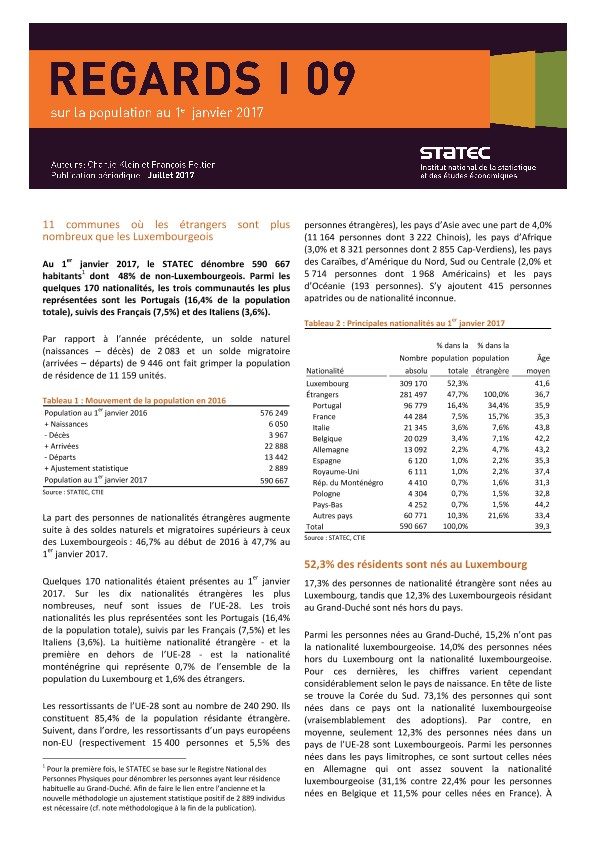
On 1st January 2017, 590 667 inhabitants were counted in the country. 47.7% of the population are foreigners. The three most represented communities are Portuguese (16.4% of the total population), followed by French (7.5%) and Italians (3.6%). At the municipal level, the share of foreigners varies between 19.3% (Wahl) and 70.7% (Luxembourg-Ville). Just over half of the residents were born in the Grand Duchy of Luxembourg (52.3%). On average, Luxembourgers are older than foreigners, respectively + 6.2 years for women and + 3.7 years for men. The population is unequally distributed across the territory. In general, the municipalities in the south of the country are more densely populated than those in the north. The biggest municipality, in term of population, is Luxembourg-Ville and the smallest Saeul.

07-17 Regards sur la balance courante en 2016
The first provisional results of Luxembourg's current account show a surplus of 2.6 billion euros. External transactions in goods and services left a surplus of 17.4 billion euros in 2016 (17.7 billion in 2015). Small changes in opposite directions (lower exports versus higher imports) have the net contribution of financial services to the current account balance decrease from 14.3 billion euros in 2015 to 14 billion in 2016. Due to restructuring and gradual departures, the external activity of e-commerce companies is dropping.

06-17 Regards sur le temps parental
In 2014, women spent five and a half hours a day with their children, two hours longer than men. The two extra hours is mainly due to domestic chores and meal preparations. The differences between women and men who work full-time are chiefly noticed when children are young. These are the results of an enquiry made with 2000 people which “Statec” publishes as part of the International Women’s Rights Day on March 8.

05-17 Regards sur l'impact potentiel du Brexit
According to the most part of studies, consequences of ' Brexit, would be negative, above all for United Kingdom, but also for the other European economies. Who in Europe is going to unwind the red carpet for the City? What are the risks and opportunities for Luxembourg and its financial place? Find all information in the publication "Regards" of STATEC.
04-17 Regards sur le budget de référence d’une famille de 4 personnes
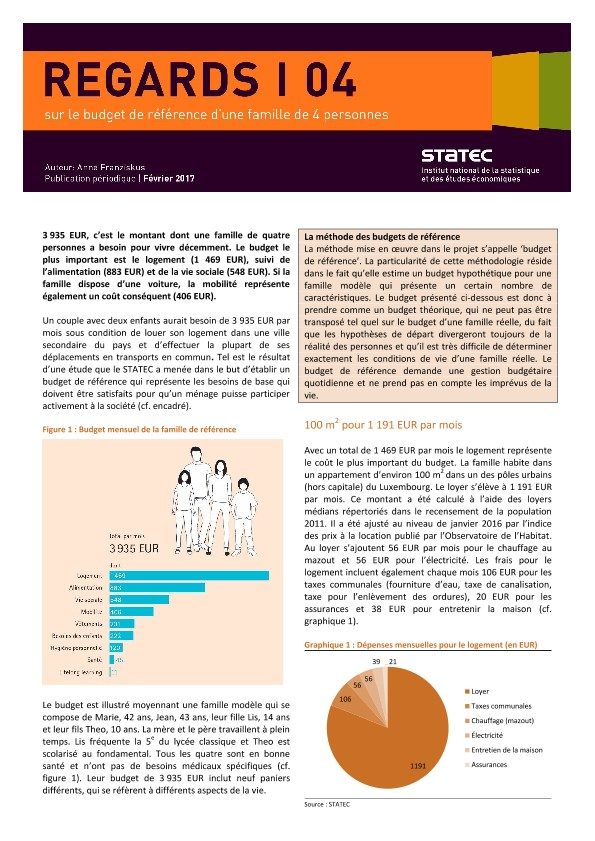
3,935 EUR is the amount that a family of four needs to live decently. The most important budget is housing (1,469 EUR), followed by food (883 EUR) and social life (548 EUR). If the family has a car, mobility also represents a substantial cost (406 EUR).
A couple with two children would need 3,935 EUR per month on condition of renting their accommodation in a secondary city of the country and using public transport most of the time. This is the result of a study carried out by STATEC in order to establish a reference budget which represents the basic needs that must be met for a household to be able to participate actively in society.

03-17 Regards sur la participation socio-culturelle des résidents
In this publication, aspects such as volunteer work, integration with family and friends and communication via social media are addressed.

02-17 Regards sur l’utilisation des TIC par les particuliers
Almost all resident households have Internet access (97%) in 2016. The few unconnected households do not need it, declare a lack of skills or have access elsewhere. They are almost exclusively households without children or teenagers in their homes. 95% of Internet users connect daily or almost daily, mostly via their smartphone (83%); 80% connect outside their home and workplace.
The 2016 special module of the ICT (Information and Communication Technologies) survey concerns "Privacy and protection of personal identity". It reveals that only 8% of Internet users have not disclosed personal information on the Internet. 4 out of 10 Internet users said they had read the privacy policy before providing personal information on the internet and 6 out of 10 had restricted access to their geographical location and / or limited access to their profile or content on social networking sites.

01-17 Regards sur la qualité des prévisions d'inflation
One of STATEC's missions is to make economic forecasts, including forecasts on inflation. Inflation is defined as the general rise in prices, as measured by the National Consumer Price Index (NCPI). This Regards explains the origin and magnitude of the observed and forecasted inflation differentials and shows that the seasonality of the NCPI further complicates the forecast of the wage indexation, as it was the case with the latest one.

23-16 Regards sur la situation des personnes âgées au Grand-Duché
On the occasion of the International Day of Older Persons, celebrated on 1 October, STATEC brought together senior statistics (60 years and more) in the Grand Duchy. On 14 December 1990 the United Nations General Assembly voted the institution of this day initiated by the Vienna International Plan of Action on Ageing in 1982. It was first celebrated on 1 October 1991.
On 1 January 2016, 111 759 residents are 60 years or more, their number increased by 14.4% over the past 5 years. 55.1% are women. Seniors spend 2 hours and 55 minutes watching TV, read 39 minutes a day and take a nap for 1 hour and 9 minutes. They do three hours and 38 minutes of housework a day. 17% of the seniors living in the Grand Duchy, still work; they are 38.3% on average in the EU28. 25% of 60 years or more participate in social networks. 6.4% of seniors had an income below the poverty risk threshold in 2014.

22-16 Regards sur la résilience et la mutation du secteur financier
The financial sector is a major pillar of economic structure of Luxembourg and this specialization has remained up to the last years. The share of financial activities in total value added has changed little, although some diversification among the various components of the sector took place, to the benefit of financial auxiliaries and at the expense of financial intermediation.

21-16 Regards sur la relation entre fluctuations boursières et performance économique
There is some similarity between the changes in stock indexes and the economic activity at European level, and this relationship is particularly significant in the case of Luxembourg. Fluctuations on European markets would affect the real GDP growth of Luxembourg with a delay of about a quarter, and even more quickly the added value of the financial sector. Although the determinants of this relationship remain to be studied, its intensity is strong enough to consider the changes in stock markets as important economic signals in regard to the expected short-term economic results.

19-16 Regards sur la situation des jeunes au Grand-Duché
On 1 January 2016, 163 454 residents are less than 25 years old; their part in the total population is continuously decreasing. Some elements on their situation: the 10 – 24-year-olds sleep on average 9 hours and 33 minutes and read on average 10 minutes a day. 29% of young residents (16 to 24) were in the labour market in 2015, slightly less than European average (33%). 11.1% of women who married in 2015 were under 25 years and 10.1% of the babies born in 2015 had as young moms. Young residents (16 to 24) seem happier than their European counterparts, but they were neither less, nor more exposed to economic and social difficulties.

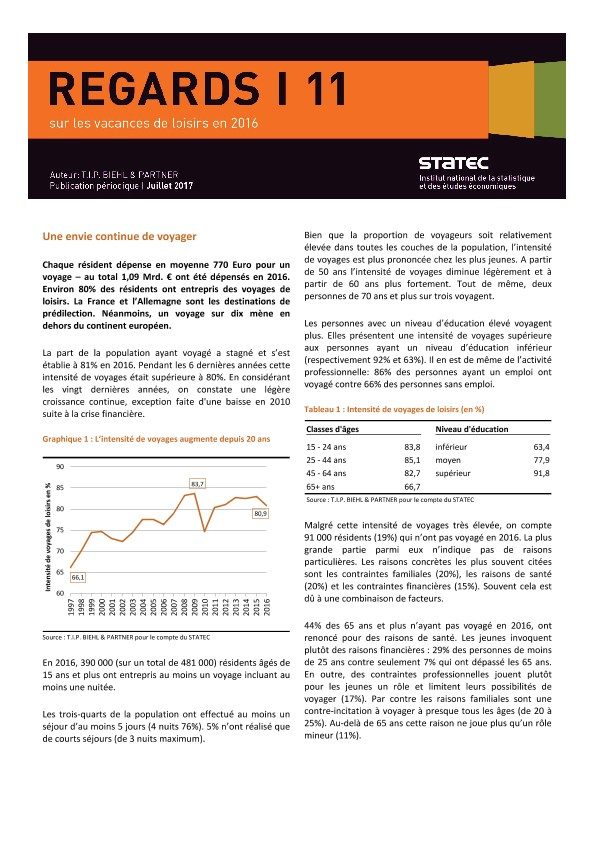
18-16 Regards sur les voyages de loisirs en 2015
Over the last 4 years, the leisure tourism activity remains stable at a high level: 83% of residents aged 15 and more did at least one leisure trip, including at least one night, in 2015. France and Germany are still the favorite destinations. Overall, nearly a journey in three (31%) is considered as relaxing trip without special activities. A trip in four (24%) is for the visiting of family or friends and one in five (19%) is dedicated to culture. The most often cited reasons for not traveling are health problems (31%).

17-2016 Regards sur l’impact de la réforme fiscale en faveur des ménages
The latest tax reform favouring households comes into effect beginning of 2017. The total budgetary cost amounts to 425 Mio EUR for 2017, a sum which includes the reduction of the marginal tax rates as well as the abolition of the temporary Budget balancing tax.

16-2016 Regards sur l’évolution de la population depuis le recensement de 2011
On the occasion of World Population Day, celebrated on 11 July, STATEC takes a look at the evolution of the population of the Grand Duchy from the 2011 census onwards. In the last five years the total population increased by 12.5%. The foreign population increased by 22.1% to reach nearly 47% of the total population on 1 January 2016. More than 90% of the foreigners living in Luxembourg are Europeans, half of them coming Portugal (34.6 %) and France (15.5%). The share of young people lightly decreases over the years. While the share of people of working age is increasing slightly, the proportion of pensioners hardly varies.

15-2016 Regards sur l’emploi culturel au Luxembourg
The percentage of people occupying a cultural job in the EU varies from 1% to 5.8%. In the Netherlands (3.9%), in Sweden (4.1%), in Iceland (4.7%) and in Luxembourg (5.8%), the cultural employment is at its highest. We estimate that cultural employment in Luxembourg occupies about 8 500 residents. In Luxembourg, more men are employed in culture. However, the share of women occupying a cultural job is higher than in total employment. The large majority of people working in culture are graduates. Cultural employment also gathers more self-employed people and fixed-term contracts.
14-2016 Regards sur les inégalités de la consommation au Luxembourg en 2014
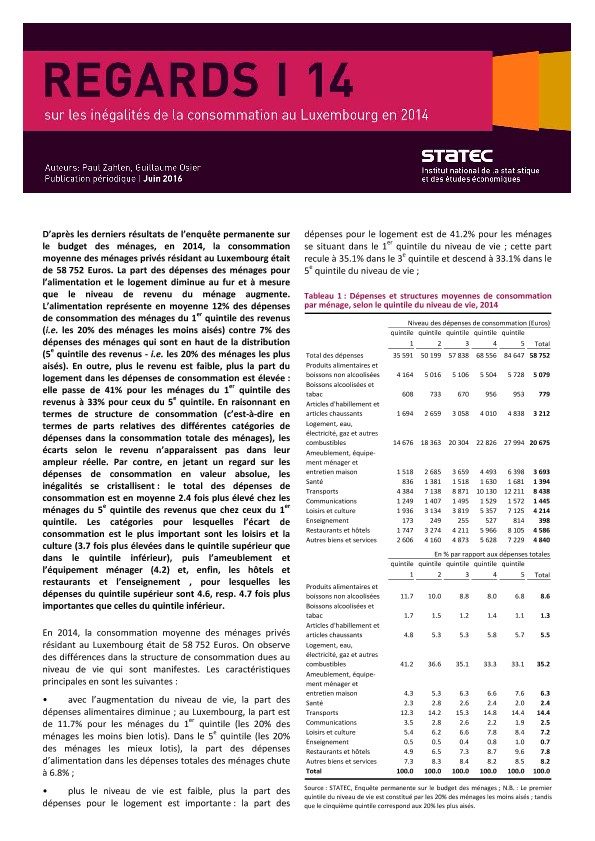
According to the latest results of the household budget survey, in 2014 the average consumption of private households in Luxembourg was 58 752 Euros. The share of food and housing expenses in the household budget decreases as the household income increases: food expenses represent 12% of the consumption of households in the first income quintile (i.e. the 20% of households which are less well off) but only 7% of the consumption of the households in the top of income quintile (i.e. the 20% of households which are most well off). The share of housing expenses in households’ consumption ranges from 41% for households in the first income quintile to 33% for households in the fifth income quintile. When analysing the structure of households’ consumption (that is, the percentage that various types of expenses represent in the households’ total consumption), little variation of consumption according to income level is found. However, looking at absolute values of consumption makes consumption inequalities according to income levels apparent: the total amount consumed by households in the fifth income quintile is on average 2.4 times larger than the amount consumed by households in the first income quintile.

13-2016 Regards sur l'utilisation des services payants d'informatique en nuage
A little more than one in ten enterprises in Luxembourg buys cloud computing services in 2014. Cloud computing presents itself as a flexible and distributed form of using IT services. This kind of product is accessible online in real-time and made available in line with the enterprise’s requirements. The services thus provided to the enterprise are paid according to a fixed or variable pricing model, e.g. based on the capacity used or on the number of users.

12-2016 Regards sur la mortalité saisonnière
Between January 1994 and December 2014, 79 592 deaths were recorded in Luxembourg. These deaths are not distributed equally among the different months of a year. We observe the highest figures in January (+ 13.9 % compared to the annual average) and the lowest in September ( -9.4 % of deaths compared to the annual average). Per season, excessive mortality in winter and lower mortality in summer and autumn is observed. The winter increase in the number of deaths occurs every year and throughout the whole period studied. This seasonality in mortality is also confirmed by statistical tests. The seasons seem to have little influence on the number of deaths by sex, nevertheless there is a seasonality in mortality by age. In summer, the risk of death is greatest for young people (0-24 years) while for the 65+ the deaths are more common in winter and spring.
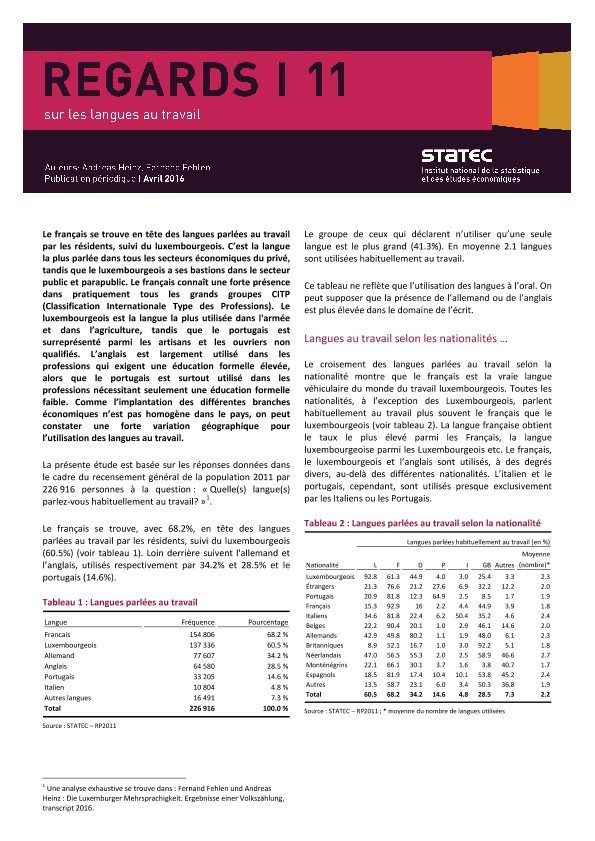
10-2016 Regards sur les langues au travail
French is the first language spoken at work by residents, followed by Luxembourgish. French is also the most spoken language in all economic sectors from the private sector, while Luxembourgish has its strongholds in the public and broader public sector. French is experiencing a strong presence in almost all major ISCO groups. Luxembourgish is the most used language in the army and in agriculture, while Portuguese is overrepresented among the craftsmen and unskilled workers. English is widely used in occupations requiring a high level of education, while Portuguese is mostly used in occupations requiring only a low level of education. As the implementation of various economic sectors is not homogeneous in the country, a strong geographic variation can be seen for the use of languages at work.
More data (german EXCEL files)

10-2016 Regards sur l'intégration linguistique
Luxembourgish born in Luxembourg differ significantly from those born abroad. Similarly, the proportions of the main languages differ among foreigners, if they were born in Luxembourg or if they are migrants. If both parents were born in Luxembourg, the main language is almost always Luxembourgish. However, if one parent is born abroad, this share decreases to around 75%. In practice, all German immigrants have German or Luxembourgish as their main language but for the French ones, Luxembourgish is less often their primary language. A high proportion of Portuguese immigrants retain Portuguese as their main language.

09-2016 Regards sur la balance courante en 2015
In 2015, the current account surplus of Luxembourg has increased by approximately 180 million euros, compared to 2014. This is due to the improved balance of international trade in financial services, which has more than offset the decline in net VAT income related to e-commerce. Furthermore, the change in business model (within Europe) of an e-commerce company has resulted in a redistribution of flows between goods and services, whose impact has however remained almost neutral on the current account surplus.

08-2016 Regards sur l'évolution de la confiance institutionnelle et politique
According to the Eurobarometer, trust in two political institutions, the parliament and the government, was still very high in Luxembourg in the early 2000s, with respectively 72% and 73% of the population claiming to have confidence in these institutions. With these values, both political institutions were located on the top of all institutions considered and that in front of the police (confidence level of 70% in 2001) and the army (65%). Trust in political parties was already quite low, compared to other institutions in the early 2000s (32% trusted the parties in 2001). For ten years, confidence in the government and in the parliament seems to have been shaken (and this structurally). In 2014, only 51% of the population of Luxembourg trust the government, 47% the parliament. Confidence in political parties, already low fifteen years ago declined further to 25% in 2014. However, the order institutions (justice, police, army) are appreciated by the people surveyed. 72% of Luxembourg residents trust the police in 2014. The army follows with 64% of the population who tend to trust this institution. Finally another order institution, justice, is relatively well positioned with 61% of people in Luxembourg who say they tend to trust this institution.

07-2016 Regards sur les inégalités de confiance
The higher the education level, the higher institutional trust and social trust are. In Luxembourg, trust in the police reached a score of 5.9 out of 10 for people with a low level of education (primary and lower secondary). The score goes to 6.5 among people with a high level of education (university type). For people with a low level of education, the confidence score in justice is 4.9 out of 10. It increases strongly to 6.1 for those with higher education level. The level of trust in the political system is generally quite low, but increases with the level of education: from a score of 4.6 out of 10 for those with a low education level, we move to 5.6 for those with high level of education. In Luxembourg, trust in justice, trust in the political system and trust in others are distributed more unevenly than trust in the police. With the exception of justice, people aged 65 and over are generally more confident in institutions and towards others than middle-aged people (35-49 years).

06-2016 Regards sur la confiance institutionnelle et sociale
In Luxembourg - as in the EU-28 average - in absolute terms, the confidence score is the highest for the police and the lowest for the political system. However, it says nothing about the relative position of the Grand Duchy in the European comparison. Confidence in the political system and confidence in the judicial system in Luxembourg exceed by far the European average, while the score of social trust (interpersonal trust) in Luxembourg is lower than the European average. There is also a strong correlation between trust in the police and interpersonal trust (social trust), but a rather weak relationship between confidence in the political system and interpersonal trust. In general, the higher the corruption perception, the lower trust in institutions.

05-2016 Regards sur la vie des femmes au Luxembourg
On the occasion of International Women's Day, celebrated on March 8, STATEC looks at women's lives in the Grand Duchy and publishes figures on their situation. International Women's Day first emerged from the activities of labour movements at the turn of the 20th century in North America and across Europe to acquire rights already granted to men (the right to vote, for example), better working conditions and equality between men and women. The United Nations celebrated International Women's Day for the first time during the International Women's Year on March 8, 1975. In 1977, the General Assembly adopted a resolution proclaiming a United Nations Day for Women's rights and international peace to be celebrated by Member States on any day of the year, according to their historical and national traditions. The UN 2016 theme for International Women's Day is "Planet 50-50 by 2030: Step It Up for Gender Equality". In the Grand Duchy, the Platform “International Women's Day (JIF2016)” has selected the unifying theme "Images of Women" this year. It claims rewarding, diverse, pluralistic and realistic "Images of Women".

04-2016 Regards sur l'emploi du temps des résidents
In 2014, the resident population aged 10 - 74 years spent a little over three months working (paid work, studies and domestic work combined), two months on leisure activities and four months resting. Rhythms change depending on the weekdays. For example, people get up early during the week: at 7 a.m., 59 % of the residents are already out of bed, against 23% on a Saturday and 11 % on a Sunday. During the week, 43 % of the population is at work in the midst of the day, but on Saturdays only 11 % does so. By contrast, residents take more time to rest and to pursue leisure activities during weekends.

03-2016 Regards sur les ménages monoparentaux
Single-parent households are at the highest risk of poverty. In 2014, 44.6% of these households have incomes below the poverty-line (60% of equivalent median income); while for all households with dependent children the poverty rate is "only" 22.4%. The poverty rate of single-parent households in Luxembourg exceeds that of the euro area average (33.8% in 2014). Poverty rates do not give information on the demographic weight of single-parent households or on the socio-economic characteristics of these households. This publication provides some data on these issues. Single- parent households make up 3.2% of all households, 9.0% of households with children and 5.1% of the population. Single parenting remains a largely female phenomenon. In 2014, the reference person in 82.7% of single-parent households is female.

02-2016 Regards sur la pratique du commerce électronique par les particuliers
8 out of 10 Internet users have purchased goods or services online in the year preceding the survey 2015. They were 6 of 10 in 2016. The practice of electronic commerce increases with the level of the diploma. By age, it is among the 25 to 34 that we find the most online shoppers (87%), but the e-commerce seduces more and more seniors. The proportion of online buyers among Internet users aged between 65 and 74 years has actually doubled over the last ten years from 34% in 2006 to 69% in 2015. In Europe, Luxembourg is placed in 4th position, behind United Kingdom, Denmark and Germany. Online purchases mainly concern clothes, travel and reading. 54% of online buyers say they have encountered a problem when shopping online. They mostly cite the problem of non-delivery in Luxembourg, followed by longer than indicated delivery times. Among the 20% of Internet users who did not practice e-commerce, most prefer to buy the products in stores or are concerned about the security of payments or the disclosure of personal data on the net. 28% of online purchases are made from national sellers.

01-2016 Regards sur la «satisfaction» dans différentes dimensions de la vie
In Luxembourg, the satisfaction scores with regard to personal relationships (8.0 in 10), with regard to housing (7.8) and the housing environment (7.8 out of 10 for the residence area, as well as for recreational areas and green spaces) are highest. Satisfaction with the financial situation reached a low score (6.9 out of 10), but in the European comparison, Luxembourg is fairly close to the front runners in this dimension. Older people are much more satisfied with their financial situation, their housing situation and their time use than middle-aged and young people. It is logically in two dimensions directly related to material living conditions, that is to say in terms of satisfaction with the financial situation and housing, that the difference in satisfaction by income is most important. The third indicator of satisfaction for which there is a fairly large gap between the top and bottom of the income scale is "satisfaction with life in general" (6.7 out of 10 in the bottom quintile, against 8.1 for the highest income quintile).

30-14 Regards sur les bâtiments achevés en 2012
The statistics on « completed buildings and dwellings » is a survey conducted since 1970 by STATEC. All the completed construction during one year are taken in account and the main characteristics of these buildings are collected, like the type (residential or non- residential , single-family house or apartment) , the surface , the volume and the cost. In this publication, we will have a look at the buildings completed during the year 2012 and more particularly on certain characteristics of these buildings, as well as the regional distribution of completed buildings and dwellings.

29-14 Regards sur l'environnement des logements et l'accès aux services
17.0% of Luxembourg residents are confronted with noise from neighbours or from the street. Luxembourg is close to the European average in this respect (19.8% in the euro area). The percentage of people who complain about pollution, grime or other environmental problems is 14.0% in Luxembourg, slightly below the European average (15.6% in the euro area). Regarding violence, crime and vandalism, 14.4% of Luxembourg residents are facing such problems in the environment of their homes; a percentage very similar to that of Belgium and France (14.7%). Income differences are reflected in the inequalities of the housing environment. 26.6% of residents whose income is below the threshold of poverty risk report of noise from neighbours or the street, against only 15.3% of non-poor. In urban areas (that is, densely populated), nearly 40% of people at risk of poverty have reported noise from neighbours or the street, against 20% of non-poor. Finally, unlike the figures for noise and pollution, the gap between poor and non-poor in the area of crime, violence and vandalism is less pronounced in Luxembourg than in neighbouring countries and the euro area average. 14.1% of Luxembourg residents who are not at risk of poverty have reported delinquency, violence and vandalism around their homes. 15.7% of Luxembourg's population at risk of poverty are in the same situation.

28-14 Regards sur la qualité du logement
Regarding the basic facilities such as indoor toilets, bathrooms, heating systems, shortages are infrequent in Luxembourg (0.1% to 0.6% of the population lives in such housing). In contrast, the proportion of people living in dwellings considered wet - leaking roof, damp walls, floors or foundation, or rot in window frames of floor - is a little higher in Luxembourg (17.1%) than the average for the euro area (15.1%). On the other hand, only 10.2% of Luxembourg's population live in homes that are not comfortably cool in summer, while the percentage reached 20.6% in the euro area on average, 18.9% in France, 13.6% in Germany. Housing quality inequalities are quite significant. 13.5% of people at risk of poverty live in housing too dark, against 5.4% of non-poor. No less than 28.9% of people living below the poverty risk live in wet housing, while this is the case for only 14.9% of non-poor. Nearly one in 10 residents at risk of poverty in Luxembourg lives in a state of severe housing deprivation.
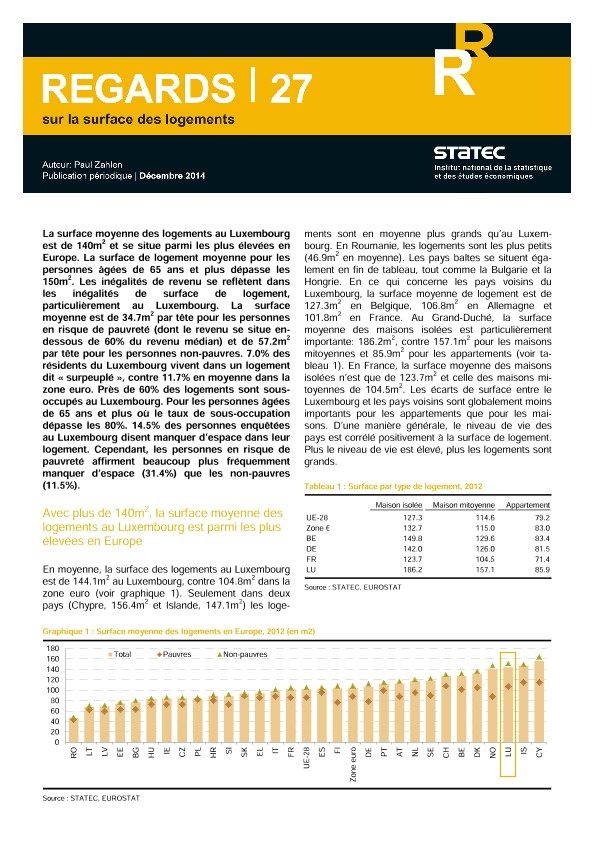
27-14 Regards sur la surface des logements
The average size of dwellings in Luxembourg is 140m2 and is among the highest in Europe. The average housing area for people aged 65 and over exceeds 150m2. Income inequalities are reflected in the housing surface irregularities, especially in Luxembourg. The average area is 34.7m2 per capita for people at risk of poverty (whose income is below the 60% of median income) and 57.2m2 per head for non-poor. 7.0% of Luxembourg residents live in an "overcrowded" dwelling, against 11.7% on average in the euro area. Nearly 60% of homes are under-occupied in Luxembourg. For people aged 65 and over, the under-occupation rate exceeds 80%. 14.5% of respondents in Luxembourg say they have a problem with a lack of space in their homes. However, people at risk of poverty are much more frequently in that situation (31.4%) than non-poor (11.5%).

26-14 Regards sur le statut d'occupation des logements
More than two thirds of Luxembourg residents are homeowners (70.8%), but for people at risk of poverty, this percentage is only 42.8%. About 4 out of 5 people aged 65 and older are homeowners and very rarely have a loan or mortgage. The ownership rate is lower for households of one adult younger than 65 years (49.0%) and single-parent households (48.7% of these households). Some 43% of Luxembourg residents live in households paying a mortgage, against only 28% in the euro area. About 14% of Luxembourg nationality residents are tenants, against about 50% of foreigners living in Luxembourg.

25-14 Regards sur la violence
A survey jointly organized by Statec and the University of Luxembourg in 2013 asked residents in Luxembourg whether they had been victims of a violent offense. Results show that 17% of respondents have been harassed during the 5 years prior to the survey (they experienced either moral harassment, threats or bullying), 4% have been victims of robbery, 9% have suffered physical harm and 4% have been aggressed sexually. Youth have been more often victims of violent offenses than older residents. Men were twice more likely to experience robbery than women whereas women were much more likely to report sexual aggressions. Victims of sexual violence were also more likely to suffer physical violence. People aged 25 to 34 are least worried about being victims of a violent offense, yet most victims are in this age bracket. While men and women are equally likely to experience violent offenses, women are more afraid of becoming victims. 38% of persons who suffered violent offenses between 2008 and 2012 have been victims of several violent offenses. The most aggressions on residents have taken place in Luxembourg (86%) and in 70% of cases the aggressor acted alone. A third of the victims knew the name of their aggressor. Violent offenses where the aggressor was known were perpetrated by ex-partners in 26% of cases.

24-14 Regards sur les dépenses alimentaires
Food spending counts for 15 % of the total household expenditures in 2012. 37 % of food spending is made of catering services and the other part is consumed "at home": 51 % to purchase non-liquid food, 6 % soft drinks and 6 % alcoholic drinks. For products consumed at home, meat is on top with 24 %. The part of the budget assigned to food is the highest for the age group of 35 - 64 years. The age group of 18-34 years is spending the biggest part of their budget for food consumed outside home. However, this remains strongly connected to the level of income.

23-14 Regards sur la durée de travail
As part of the quadrennial survey on labour cost, STATEC conducted a thorough analysis of working time.
The main conclusions of this analysis are:
- With 1773 hours per year in 2012, the average working hours (for a full-time equivalent) declined slightly compared to 2008, after having increased during the decade before ;
- The number of hours actually worked in Luxembourg remains above the European average, neighbouring countries and neighbouring regions ;
- In Luxembourg, 17.5% of employees work part-time, against 25.3% on average in the European Union ;
- Overtime is down ;
- Absences are stable.
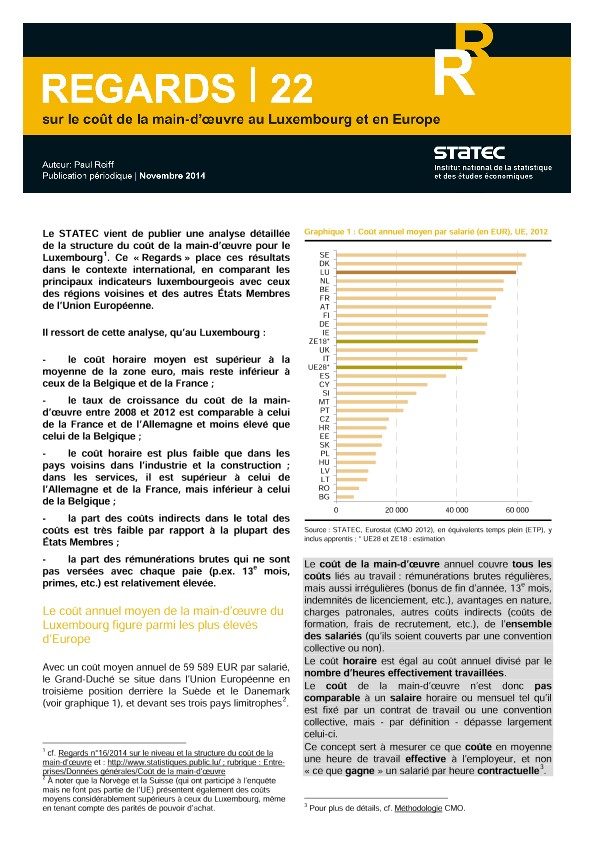
22-14 Regards sur le coût de la main-d’oeuvre au Luxembourg et en Europe
STATEC compares key indicators of labour cost in Luxembourg with those of neighbouring regions and other member states of the European Union.
This analysis shows that in Luxembourg:
- The average hourly labour cost is higher than on average in the euro area, but below those of Belgium and France;
- The growth rate in the labour cost between 2008 and 2012 is comparable to that of France and Germany and lower than that of Belgium;
- The hourly cost is lower than in neighbouring countries in industry and construction, in services, however, it is higher than that of Germany and France, but lower than in Belgium;
- The share of indirect costs in the total cost is very low compared to most Member States;
- The share of gross wages that are not paid with each pay period (e.g. 13th months, bonuses, etc.) is relatively high.

21-14 Regards sur la présence de drogue
Data from a victimisation survey collected by Statec in 2013 show that 35% of residents aged 16 and over have seen in their neighbourhood drug users, drug dealers or objects related to the intake of drugs during the past 12 months. Such observations have more often been made by young persons and residents of urban areas. Persons who “often” observed drug dealers and drug consumers in their neighbourhood report feeling more insecure, going out less after dark or avoiding certain streets. These persons also feel they face a higher risk of being victims to pick-pocketing, robbery and burglary. However, when encounters with drug dealers or drug users are only exceptional, they do not seem to leave a mark on the feeling of insecurity of the residents.
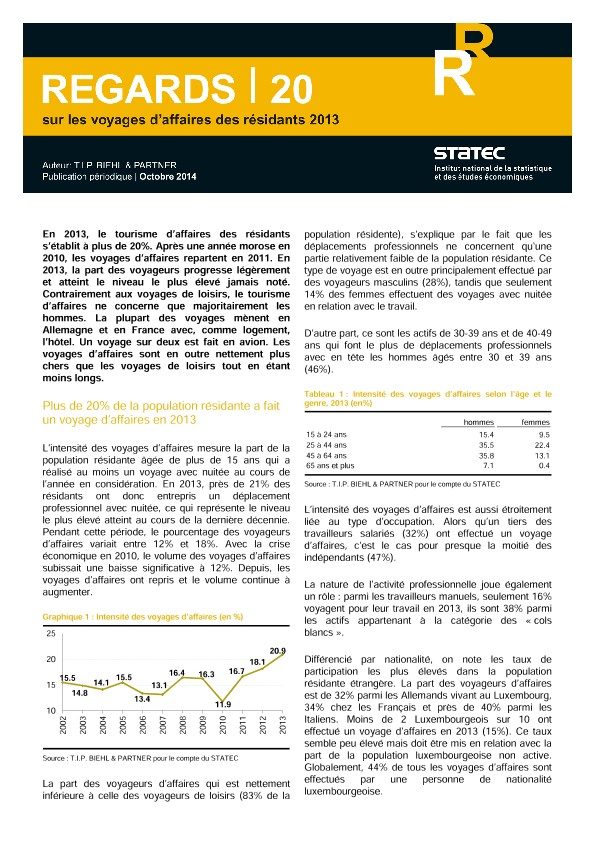
20-14 Regards sur les voyages d'affaires des résidants 2013
In 2013, 20% of the resident population made a least one business trip with at least one overnight stay. After a slight decline in 2010, business trips restarted in 2011, reaching in 2013 the highest level ever. Business trips are mainly done by men, the main destination is situated in Germany or France. The business people are mainly accommodating in hotels, and for one of two business trips, they travel by plain.

19-14 Regards les répercussions émotionnelles ressenties par les victimes de délits
35% of victims report that acts of violence have had a strong emotional impact on them. Seniors are less often victims of crime than younger people, but their emotional response is more often a strong one. Similarly, women are less frequently victims of crime than men, but if they experience crimes, their emotional reaction is stronger. People who had strong emotional reactions to the crimes they have experienced feel less safe in their neighborhood and believe they are more vulnerable to other crimes.
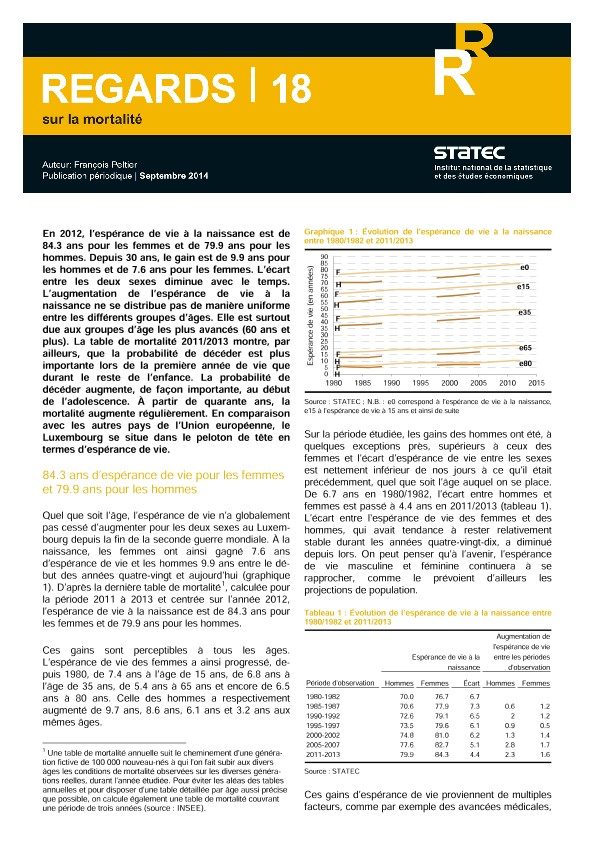
18-14 Regards sur la mortalité
At the moment, the life expectancy at birth is 84.3 years for women and 79.9 years for men. Since 30 years, the increase is 9.9 years for men and 7.6 years for women. Luxembourg is in the leading European countries in terms of life expectancy. The increase in life expectancy at birth is not distributed uniformly among the different age groups. It is mainly due to the older age groups (60 and over). The table 2011/2013 shows, moreover, that the probability of decease is higher during the first year of life than during the rest of childhood, where mortality is low. The probability of decease increases significantly in early adolescence. From the twenties onwards, it is less pronounced. From 40 years onwards, mortality is steadily increasing.

17-14 Regards sur la méthode de calcul de la production des institutions financières
Part of the services provided by financial institutions is not explicitly charged to their customers in the form of commissions, fees or other, but consists of the difference between interest receivable and payable. This interest can be decomposed into a "pure" interest (capital income) and compensation for the intermediation services provided by financial institutions. However these services are not directly measurable because they are not charged, and therefore must be estimated by national accountants. That is why they are called financial intermediation services indirectly measured (FISIM). In the EU, the treatment of FISIM has changed with the release of the new version of the European System of Accounts (ESA 2010). The impact is particularly noticeable in Luxembourg, because of its large international financial center. This methodological change, not taking into account other ESA 2010 related revisions, raised the GDP of Luxembourg by + 0.5% in 2008.

16-14 Regards sur le niveau et la structure du coût de la main-d'oeuvre
STATEC has just published the detailed results of its four-yearly labour cost survey. This "Regards" presents key indicators of the level of labor costs in the Grand Duchy and a detailled analysis of the various components of that cost. The average hourly cost is 33.91 euros in 2012, against 30.96 euros in 2008, corresponding to an average growth of 2.3% per year. In the financial and insurance sector, it is three times higher than in the administrative and support services sector and the accommodation and food service activities. Wages and salaries account for 86% of that cost, whereas employers’ social contributions represent 13%. The share of remunerations that are not paid with each salary (e.g. year-end bonuses etc.) has declined in comparison to 2008 but still accounts for 9.5%.

15-14 Regards sur les cambriolages
During the last 5 years, 10% of the households have been the victim of a burglary and another 5% have been the victim of a burglary attempt. 34% of people are afraid of being the victim of a burglary during the next 12 months. Who are these people? Where do they live? Answers to these questions are provided by the safety survey 2013.

14-14 Regards sur la capitalisation des dépenses de Récherche et Développement
To better reflect economic reality and because of progress made in statistical sources and methods, the revised European System of Accounts (ESA 2010) changes the treatment of Research and Development (R&D) expenses in national accounts. Research and Development (R&D) is now recognized as a fixed asset which does not disappear in the production process. In other words, the R&D expenses of the economy are no longer recorded as intermediate consumption, but as capital formation.
Two pilot exercises conducted by Eurostat have shown that the impact of this methodological change would lead to an increase of 1.3 % of the GDP of Luxembourg and of 4.7 % of its capital formation. Among all methodological changes of ESA 2010, capitalization of R&D expenses has the most important impact on GDP.

13-2014 Regards sur l'impact de l'économie illégale sur l'économie luxembourgeoise
Prostitution and trafficking of drugs are the two main components of illegal activities in Luxembourg. These activities are part of national wealth, as measured by gross national income (GNI), by the revenues they provide to some residents. Eurostat, in close cooperation with European Union member states, has defined a methodological framework for integrating such illegal activities into the national accounts. Comparability between member states has been a prime objective. The estimates for illegal activities will be included in member states accounts according to the revised European System of Accounts (ESA 2010) by September 2014. After a first estimate of illegal activities in 2006, STATEC undertook an impact assessment on both gross domestic product (GDP) and gross national income (GNI) for the year 2012. The impact is about 0.3% of both GDP and GNI. Although relatively low, these activities are nevertheless significant, especially when directly compared to certain industries of the legal economy.

12-2014 Regards sur la protection des logements privés et la vidéo-surveillance publique
The 2013 safety survey indicates that in Luxembourg, 27% of homes are equipped with a burglar alarm and 57% have special safety locks. Detached or semi-detached houses are more often provided with both of these security measures than row houses and apartments. According to the same source, 70% of residents believe that video surveillance of public places in Luxembourg increase their own safety, 23% think that it has no impact and 3% are even of the opinion that it reduces their own safety.

11-2014 Regards sur les voyages de loisirs des résidents 2013
After some reluctance to travel in 2010, the positive development of tourism activity holds on. In 2013 83% of the residents in Luxemburg have realised at least one overnight trip for personal reasons. The main reason for travelling in summertime was leisure or recreation at seaside. Reasons for not travelling were mainly due to health problems.

10-2014 Regards sur les avantages en nature des salariés en 2012
Non-cash employee income consists of goods or services which companies may offer for free or at a reduced price to their employees, for either private use or both private and work use. Non-cash employee income may include a company car or a mobile phone as well as their associated costs, the reimbursement or payment of housing-related or transport-related expenses, access to a company canteen, free or subsidised lunches, luncheon vouchers, but also discounted prices for buying certain goods or the possibility to contribute to a company pension plan etc. Non-cash employee income is part of employee compensation and is thus subject to social contribution and income tax. As of 2007, the European Union Survey of Income and Living Conditions (EU-SILC) assesses the monetary value of non-cash employee income. Based on this assessment, this publication analyses the importance of non-cash employee income as a component of national employee income.

09-2014 Regards sur la révision des comptes nationaux et de la balance des paiements
Luxembourg's national accounts and balance of payments macroeconomic statistics will undergo two major changes in September 2014. The first one relates to revision of the methodological framework of the European system of accounts (ESA 2010) and the balance of payments manual (BPM6). The second one is the result of a periodical data revision. The simultaneous implementation of the revised ESA in all EU member states revises a limited number of methodological conventions in order to make them stick more closely to the latest economic developments. However the general framework of the accounts stays widely untouched. The most notable impact in Luxembourg's accounts will result from the capitalisation of R&D expenditures and a change in the definition of financial intermediation services indirectly measured (FISIM). A first impact assessment on GDP of the ESA 2010 methodological changes shows a level shift between plus one and two percentage points.

08-2014 Regards sur l'évaluation du travail de la police
The results of the 2013 safety survey show that 86% of residents think that the luxembourgish police is doing a "very good" or a "good" job. This appreciation varies with the profile of the respondents. Victims of crime are less satisfied with the work of the police than "non-victims".

07-2014 Regards sur l'e-gouvernement
On the occasion of the World Telecommunication and Information Society Day, STATEC examined the use of e-government in Luxembourg. In 2013, nearly 60% of the residents aged between 16 and 74 who had Internet access have had online interactions with public services or authorities. Most of them were satisfied with those services. The proportion of e-government users among the Web connected residents was higher in Luxembourg than in most of the EU-28 members. Half of the internet users in Luxembourg have downloaded forms created by public authorities from the Web, more than one out of three users have searched and found information on public authorities’ websites and more than a quarter of them have filled in and sent online forms to public authorities. Residents who have not filled in such online forms mostly did not do so because they did not need to. Furthermore, 42% of them state that they prefer face-to-face contact to online interaction and 39% of them say that they trust more the paper version of a form.

06-2014 Regards sur les familles
On the occasion of the International Day of Families celebrated on 15 May, STATEC presents some aspects of the situation of families in the Grand Duchy of Luxembourg. 81.9% of the population counted at the 2011 census, live in family households, i.e. households with at least two persons and with at least two persons having a direct family relationship.

05-2014 Regards sur les accidents de travail et les problèmes de santé liés au travail
On the occasion of the World Day for Safety and Health at Work (April 28) and Labour Day, STATEC focuses on accidents at work and work related health problems. Over the past 12 months, 3.8% of workers have been victims of accidents at work resulting in injury, and 8.1% report having suffered from health problems that have been caused or made worse by work. Two out of three workers report that they are exposed to risks to their physical health in their workplace; one in two workers is exposed to risks to his/her mental well-being.
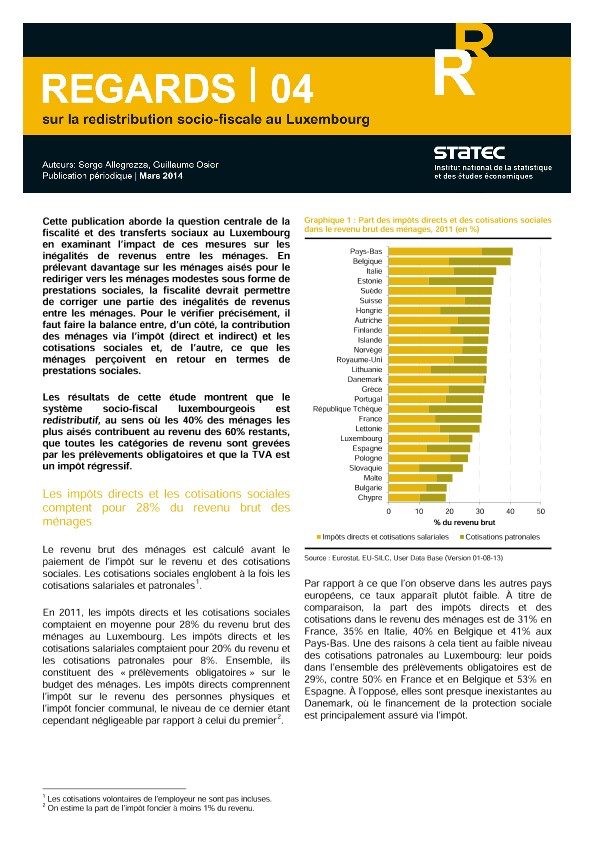
04-2014 Regards sur la redistribution socio-fiscale au Luxembourg
This publication addresses the redistribution of income among households in Luxembourg. Net transfers to households, computed by subtracting taxes on income, on consumer expenditures and social contributions from gross social benefits (including pensions and family allowances) depict the redistributive power of the Luxembourg social system. when considered by equivalised income classes. The results of this study show that the tax and transfer system is quite redistributive, in the sense that 40% of the wealthiest households contribute to the income of the remaining 60%. It appears that all income classes are burdened by compulsory levies (tax income, value added tax and social contributions) and that VAT is regressive.

03-2014 Regards sur l'emploi des femmes
The employment rate of women aged 25-49 has increased from 42.9% in 1983 to 76.5% in 2012. Among the men of the same age, the rate went down from 95.7% to 91.6%. Despite this convergence, the employment gender gap remains one of the highest in Europe. Due to expansion of part-time work, more and more women are able to reconcile work and private life. The very popular single male breadwinner model is on the wane.

02-2014 Regards sur la transition de la vie active vers la retraite
The employment rate of people aged between 50 and 64 has risen sharply over the past 30 years. Longer life expectancy has led to reflections on the adaptation of pension systems. A well-organized transition from working life to retirement has therefore become a concern for more and more people aged 50 or above. This Regards tries to draw a picture of the ways in which the transition from working life to retirement takes place in Luxembourg.

01-2014 Regards sur l'utilisation des TIC par les résidants
In 2013, 94.5% of households in Luxembourg have internet access at home. This high rate of connection places Luxembourg at the top of European level. 87% of internet users are connected almost every day. Outside home or workplace, 71% of residents surf via a mobile device, and most often via a mobile phone. The spreading of mobile Internet decreases with the age of the users. 77% of 16-24 years surf via their mobile phones outside their home and their workplace against 37% of the 55 years and older. Online shopping has seduced 62% of users. Top purchases are books, magazines and newspapers, followed by reservations of holiday accommodations. 82% of Internet users read news, newspapers or magazines online. This is the most popular cultural activity among Internet users, followed by listening or downloading music.

24-2013 Regards sur le sentiment de sécurité des résidents au Luxembourg
The safety survey has been conducted in 2013 in Luxembourg. This survey asks different questions in regard to the residents’ perceived security level in their neighborhood, their concerns regarding different types of crime, as well as measuring their satisfaction with the police and courts performances. Preventive security measures (such as intruder alarms, multiple anchors doors or armored doors) are also among the topics covered by the survey. The proportion of delinquencies reported to the police will also be investigated.

23-2013 Regards sur la sécurité et les délits au Luxembourg
The safety survey has been conducted in 2013 in Luxembourg. This survey covers different types of delinquency. The survey considers delinquencies that may have occurred between 2008 and 2013 in Luxembourg or abroad and that affected residents aged 16 or older. These delinquencies not only include incidents which were reported to the police, but also those that were not reported. This collected data helps to provide a new vision of delinquency data in Luxembourg.

22-2013 Regards sur le coût du logement pour les ménages
This publication addresses the problem of the cost of housing for the households in Luxembourg. This issue has grown central as housing prices have been steadily increasing over the last years. In 2012, more than 80% of the households consider that housing costs are a financial burden. However, when we express those costs as a percentage of household income, the situation of Luxembourg is not worse than that of other European countries. Such a result "on average", however, masks inequalities which may be important from one household to another.

21-2013 Regards sur le chômage des jeunes
In 2012, the unemployment rate for young people, from 15 to 24 years old, was 18.8% in Luxembourg and 23% in the European Union. The youth unemployment rate is the proportion of the active young people who are unemployed and not the proportion of all the young people who are unemployed. These high figures are on the one hand due to an increase in the number of young unemployed (+35% in 30 years). On the other hand, the active population in the 15-24 age class has decreased by 52%, as the young stay longer at school. Finally, in Luxembourg 5.1% of all the young people age from 15 to 24 are unemployed, compared to 9.7% in the European Union.
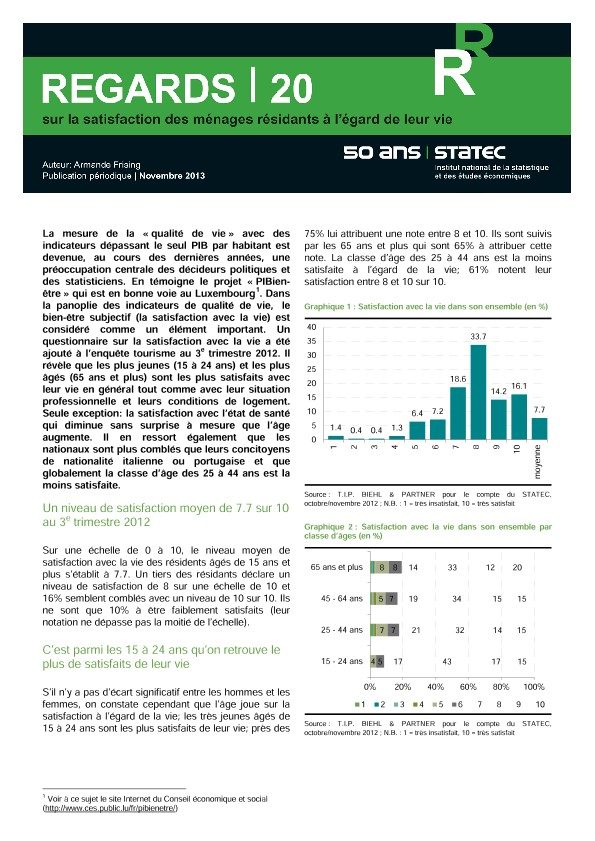
20-2013 Regards sur la satisfaction des ménages résidants à l'égard de leur vie
In recent years, the measure of "quality of life" with indicators going further than the standard GDP has become a major concern of policy makers and statisticians. The project “PIBien-être” (GDP Well-being) which is in full progress in Luxembourg clearly reflects this. Among quality of life indicators, subjective well-being (satisfaction with life) is considered as a key element. A questionnaire on satisfaction with life was added to the tourism survey in Q3 2012. It reveals that the youngest (15-24 years) and older (65 and more) are the most satisfied with their life in general as well as with their professional situation and housing conditions. Only exception: the satisfaction with health which decreases unsurprisingly as age increases. It also indicates that nationals are more satisfied than Italian or Portuguese residents and that the age class 25 to 44 years is generally the least satisfied.
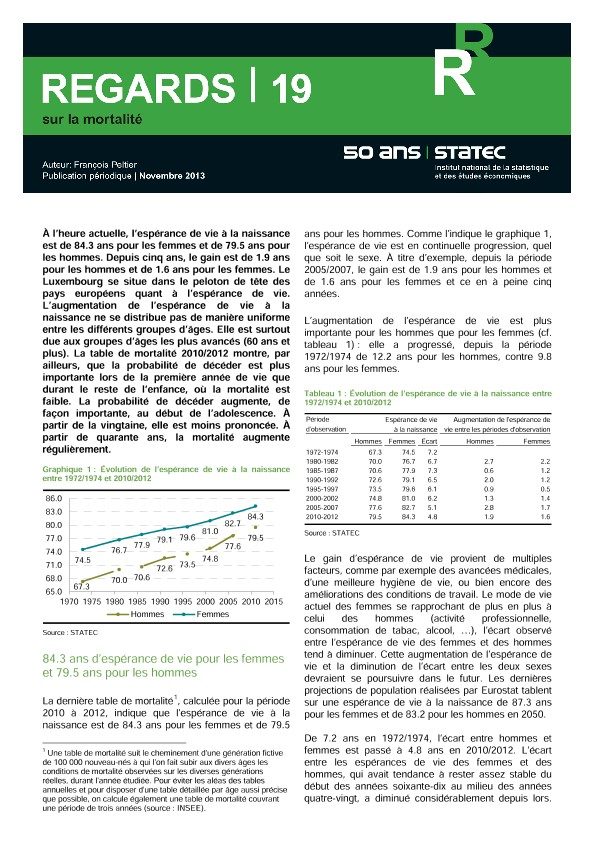
19-2013 Regards sur la mortalité
At the moment, the life expectancy at birth is 84.3 years for women and 79.5 years for men. Since the last five years, the augmentation is 1.9 years for men and 1.6 years for women. Luxembourg is in the leading European countries in terms of life expectancy. The increase in life expectancy at birth is not distributed uniformly among the different age groups. It is mainly due to the older age groups (60 and over). The table 2010/2012 shows, moreover, that the probability of death is higher during the first year of life than during the rest of childhood, where mortality is low. The probability of death increases significantly in early adolescence. From the twenties, it is less pronounced. From 40 years, mortality is steadily increasing.

18-2013 Regards sur les voyages d'affaires des résidants 2012
In 2012, the business travel intensity is 18.1%. Nearly one out of five residents, aged 15 and more, has made at least one business trip with at least one overnight stay. After a slight decline in 2010, business trips restart in 2011, reaching in 2012 the highest level of the past 10 years.

17-2013 Regards sur l'emploi à temps partiel
The part-time work remains a largely female phenomenon. In 2012, 35.9 % of women worked part-time in Luxembourg, while the corresponding rate for men was only 4.3 %, one of the lowest rates in the EU -28. The rate of part-time work overall (men and women) in Luxembourg is 18.3 % in 2012. In 2012, on all persons working part-time, 86.8 % were women. However, since 2004 the female part-time work seems to settle in relative terms: 36.6 % of women worked part-time in 2004, against 35.9 % in 2012. The proportion of men working part-time, while remaining at a very low level, however, increased significantly: 2.3 % of men worked part-time in 2004, against 4.3 % in 2012. The frequency of part-time is still largely determined by the presence of children ... for women. In 2012, the percentage of women in employment, not having children and working part-time was 24.9 %. For women with one child, the rate rises to 37.9%. The share of part- time reaches 48.3 % for women with two children and 53.4 % for women with three or more children. For men, the rates are less than 5 % for all family situations. Involuntary part-time is not widespread in the Grand Duchy. In the euro area, in 2012, the rate of those who reported working part-time because they could not find a full-time job reaches nearly 30 % of all those who work part-time. In Luxembourg, the rate of involuntary part-time is only 13.7 %.

16-2013 Regards sur le taux d'emploi
The employment rate - that is to say, the proportion of people employed in a certain age group, 20-64 years here - is increasing in Luxembourg. It goes from 67.2% in 2003 to 71.4% in 2012. This increase is due exclusively to women: while the employment rate for men remained stable at around 79% that of women is increasing from 55.1% in 2003 to 64.1% in 2012. The female employment rate in the Grand Duchy now exceeds the average for the euro area (61.9%). It is the employment rate of women with children which is largely responsible for the increase in the female employment rate. The employment rate for women without children increased only moderately by moving from 60.5% in 2005 to 64.4% in 2012 (3.9% points increase). In contrast, during the same period, the employment rate for women with one child increased from 68.0% to 73.7% (i.e. more than 5.7% points). For women with three children, the employment rate is the lowest, but the increase is not negligible for these women, the rate changes from 47.8% in 2005 to 55.5% in 2012, which represents an increase of 7.7 % points. Regarding employment rates by age classes it is that of persons aged 55-64 years which increased the most in Luxembourg. In this age group, the employment rate was 30.3% in 2003, but it reached 41.0% in 2012, a difference of +10.7 % points. In the age group of 25-54, there is also a (weaker) upward trend in the employment rate from 77.8% to 83.1%.

15-2013 Regards sur le profil des électeurs
Voters represent 57.4 % of the total population - Luxembourg and foreigners- aged 18 and over. In the voter district Centre, the share is only 45.4 %. People aged 60 and over account for nearly a third of the voters. Half of voters have a job (49.9 %) and a fifth is retired (21.1 %). 2.6 % of voters are unemployed and 7.8 % are pupils or students. A little more than half of voters (51.1 %) are employed in the private sector and 36.3 % are public officials (civil servants, manual workers, employees). Nearly half of the voters (44.3 %) are working in the public and broader public sector, that is to say in public administration, education and health and social work and only one voter out of ten works in industry and construction. 42.0 % of all voters have reached a "medium" level of education (completed secondary education) and nearly a third of voters (31.4 %) a “low” level of education (primary and lower secondary). A quarter of voters (23.8 %) have a “higher” level of education (tertiary). Professions can be grouped into four broad classes. The "skilled white collar" (executives, intellectual and scientific professions, technicians) represent 47.3 % of the total electorate. Their share is the highest in the voter district Centre (57.3 %) and lowest in the northern district (39.0 %). The "unskilled blue collar" (unskilled manual workers ) represent 11.3 % of the total electorate . In the northern and southern voter districts, this category is more present, with 13.8 % and 12.5 %, respectively, against only 8.2 % in the Centre district and 10.7 % in the East district. The most common type of household among voters is the "couple with child(ren)”: 37.2 % of the voters are living in such households. In the total electorate, the proportion of people living in households consisting of a couple without child(ren) is 23.2 % and the proportion of people living alone is 17.0 %.

14-2013 Regards sur le volume du tourisme et le comportement de voyage des résidants 2012
In 2012, the travel intensity of the residents of the Grand-Duchy remained quasi stable. After an intense decline in 2010, she found a positive trend over the past two years. In 2012, 81% of the population aged at least 15 years have taken at least one trip.

13-2013 Regards sur la création nette d'emploi depuis la crise
In the aftermath of the crisis, unemployment has worsened in Luxembourg as in most other European countries. If unemployment has increased, this does not mean that there was no job creation. Since the beginning of this millennium there was an annual net job creation in Luxembourg, although the pace of growth has decelerated significantly since the crisis. This publication aims to provide an analysis of the evolution of the net job creation, globally, by country of residence and nationality as well as by sector and branch of activity.

12-2013 Regards sur des effets des transferts et des prélèvements sur le niveau de vie
In addition to cash benefits - which are included in household disposable income - social transfers in kind (reimbursement for health care, pharmaceuticals, transfers in kind related to education, …) also contribute the standard of living of the inhabitants of a country. Adding in-kind transfers to disposable income, the "adjusted" disposable income is obtained. In 2011, in-kind transfers reached the amount of 8,350 euros per capita in Luxembourg. By adding this amount to household disposable income per capita (30 950 euros), "adjusted" disposable income is 38 300 euros in 2011. In other words, with social transfers in kind, the standard of living per capita is 27% higher than without these transfers. Since 2008, in-kind transfers are evolving faster than disposable income. As a result, the living standard with in-kind transfers is, in 2011, 5.6% higher than in 2006, against 4.2% without these transfers in kind. In principle, an increase in cash social benefits and social transfers in kind is neutralized (in public accounts), if contributions (taxes and social contributions) of households increase in the same proportions. In most European countries this is not the case and the balance of taxes and benefits and social transfers to households - already positive before the crisis - rose sharply in 2008 and 2009. In 2010 and 2011, the increase in compulsory deductions /taxes social contributions) on household income leads to a stabilization. A positive balance of taxes and transfers to households means that, without the tax revenues from other sources (indirect taxes, corporate taxes, ...), the balance of public finances is in question. In a period of sluggish economic growth, these tax revenues are obviously less dynamic.
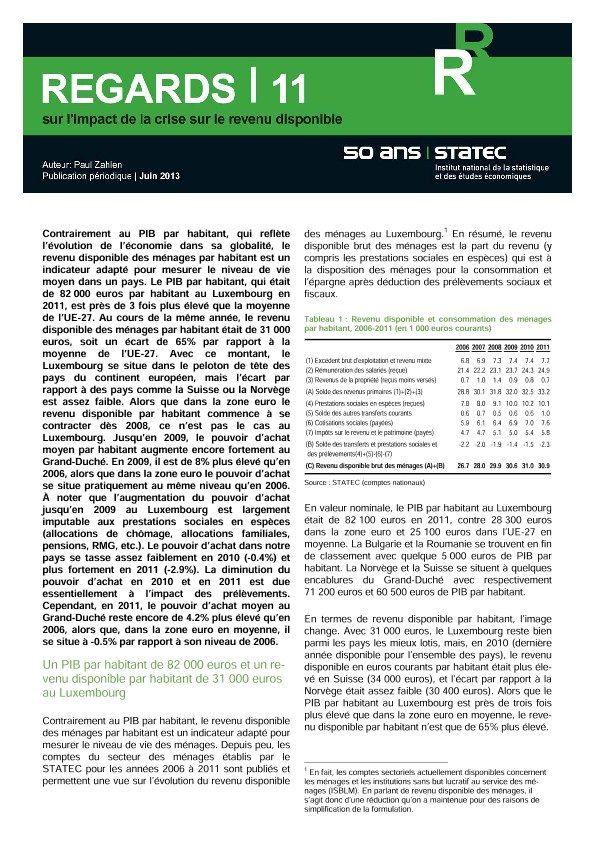
11-2013 Regards sur l'impact de la crise sur le revenu disponible
Unlike the GDP per capita, which reflects the evolution of the economy as a whole, the disposable income of households per capita is a suitable indicator for measuring the standard of living in a country. GDP per capita, which was € 82,000 per inhabitant in Luxembourg in 2011, is nearly three times higher than the average of the EU-27. During the same year, the disposable income per capita was € 31,000, a difference of 65% compared to the average of the EU-27. With this amount, Luxembourg is in the forefront of the European continent, but the difference compared to countries such as Switzerland or Norway is quite low. While in the euro area per capita disposable income begins to contract in 2008, this is not the case in Luxembourg. Until 2009, the average per capita purchasing power is still increasing strongly in the Grand Duchy. In 2009 it was 8% higher than in 2006, while the euro zone's purchasing power of household disposable income per capita was almost at the same level as in 2006. The increase in purchasing power until 2009 in Luxembourg is largely attributable to cash social benefits (unemployment benefits, family allowances, pensions, minimum income,..). The purchasing power in our country decreases slowly in 2010 (-0.4%) and more strongly in 2011 (-2.9%). The loss of purchasing power in 2010 and 2011 is mainly due to the impact of compulsory deductions on income. However, in 2011, the average purchasing power in the Grand Duchy is still 4% higher than in 2006, while in the euro area average, it stands at -0.5% compared to its level of 2006.
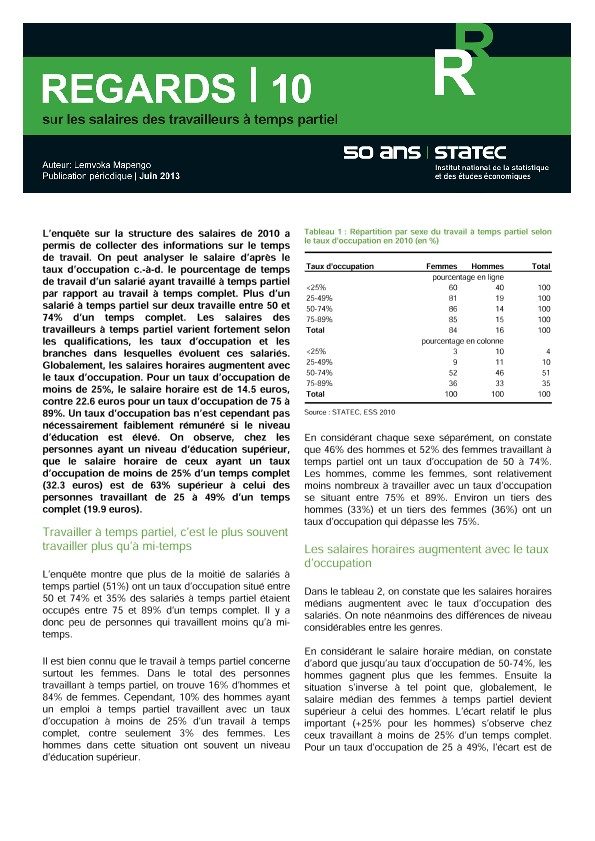
10-2013 Regards sur les salaires des travailleurs à temps partiel
The structure of earnings survey of 2010 allows analysing the wages of part-time workers according to their degree of occupation. More than half of the part-time employees work between 50 and 74% of a full-time employee. Salaries for part-time workers greatly depend on qualification, occupation and the industry. Overall, hourly wages increase with the degree of occupation. A low occupation rate is however not necessarily low-paid if the level of education is high.

09-2013 Regards sur le travail à temps partiel
In 2010, 15% of the employees had a part-time job. However, this figure masks a wide disparity between men and women. In fact, more than one woman in three (35%) has a part-time job. For men, part-time concerns only 4% of workers. These figures have remained unchanged from 2006. Part-time work is more prevalent in the sector of health and social work (40% of total employment), followed by education (28% of employment), and finally in the hospitality and catering industry (21%). 45% of women in administrative and support services work part time, but only 3-4% of men. Nearly half of women with low education work part-time, against less than 5% of men with this level of education. Finally, the share of female part-time workers passers from 18% for those less than 30 years old to nearly 50% for the 50-59 years old.

08-2013 Regards sur les internautes au Luxembourg et dans l'UE27
In the context of the World Telecommunication and Information Society Day, celebrated Mai 17th, Statec takes a closer look at the Internet users in Luxembourg and in the EU27. In 2012, 93% of households in Luxembourg had Internet access at home, but only 68% had a broadband connection. The digital divide in the EU27 has fallen sharply over the past five years, but remains high. With 81% of residents using the Internet every day, Luxembourg is the European leader in the use of the Internet followed by the Scandinavian countries and the United Kingdom. In terms of daily Internet use, social disparities are still important: 94% of individuals who have completed a higher educational level access daily to the web while the proportion is 53% among the individuals with lower educational. The most common Internet activities are emailing, products or services up looking, online news and banking and travel services.

07-2013 Regards sur les piétons impliqués dans des accidents corporels de la route
During the Second UN Global Road Safety Week, to be held 6-12 May 2013, and dedicated to safety of pedestrians, STATEC takes a look at pedestrians involved in road accidents in 2012.
In 2012, in 193 road accidents pedestrians were injured. Six pedestrians were killed in a road accident, 64 pedestrians were seriously injured and 130 escaped with minor injuries. The majority of these accidents occurred in urban areas. Children and the elderly are the most vulnerable. Half of the pedestrians were injured at a crosswalk.

06-2013 Regards sur la couverture des conventions collectives de travail
Collective agreements are agreements between trade unions and employers' organizations, which relate to working conditions. In Luxembourg, 59% of employees are covered by collective agreements. Outside the public sector, the highest coverage rate is observed in the health and social work activities (87%) and the lowest in the accommodation and food service activities (13%). Among blue-collar workers, 72% are covered by a collective agreement. Among the white collar workers the coverage rate is 51%. Furthermore, it is mainly the workers belonging to the “middle classes” who benefit from the coverage of collective agreements.

05-2013 Regards sur la balance des paiements 2012
The first results concerning the current balance of payments of Luxembourg for 2012 confirm the structural evolutions observed over the years that continue to amplify furthermore: record surplus of international trade in services facing historical deficit of trade in goods and for income.

04-2013 Regards sur la transmission intergénérationnelle des avantages et désavantages sociaux
This publication presents the main results of the 2011 module of EU-SILC (EU Statistics on Income and Living Conditions) dealing with the intergenerational transmission of social advantages and disadvantages. For each individual, we compare its current socio-economic situation with that of its parents when he/she was 14. The objective is to investigate whether social disadvantages (and advantages) are transmitted from one generation to the next, for example, the level of education, the type of occupation, the financial situation or even the health condition. Therefore, social inequalities between adults would be also the consequence of inequalities in childhood.

03-2013 Regards sur la perception de la santé
72.5% of Luxembourg residents claim to be in good or very good health (26.0% very good and 46.5% good health). In contrast, 7.9% of the population of Luxembourg say they are in bad or very bad health. Nearly 20% believe that their health is average. Other indicators of perceived health: 19.0% of the residents consider to be limited in their daily activities because of a health problem for at least 6 months and 20.9% mentioned a long-standing illness or health problem. Perception of health deteriorates sharply with age. Almost half of the 75-84 year old (45%) say they are limited in their daily activities. For the 55-64 age group, the percentage is 26% and for the 16-24 age group, it is only 6%. Older women face more often health problems. 53% of women aged 75-84 feel limited in their daily activities because of a health problem, against only 36% of men in this age group. 30.3% of women aged 75 to 84 claim to be in bad or very bad health, against only 16.5% of men in this age bracket. Life expectancy at birth for women is 5 years higher than that of men: 83.6 years against 78.5 years. However, the difference in life expectancy in good health between men and women is quite small. At age 65, men can expect to live 17.8 years, but only 11.5 years without limitation of daily activities (healthy life years). Women at the age of 65, have a life expectancy of 21.6 years, but the number of years of life without limitation of daily activities is only 11.8 years. Inequalities in health are significant. Over 23% of those located in the first income quintile (the 20% lowest income) reported an activity limitation due to health problems, whereas the corresponding figure is only 14% for those with the highest incomes (fifth quintile). 32.2% of the unemployed feel limited in their daily activities because of a health problem, against 12.5% of employed persons.
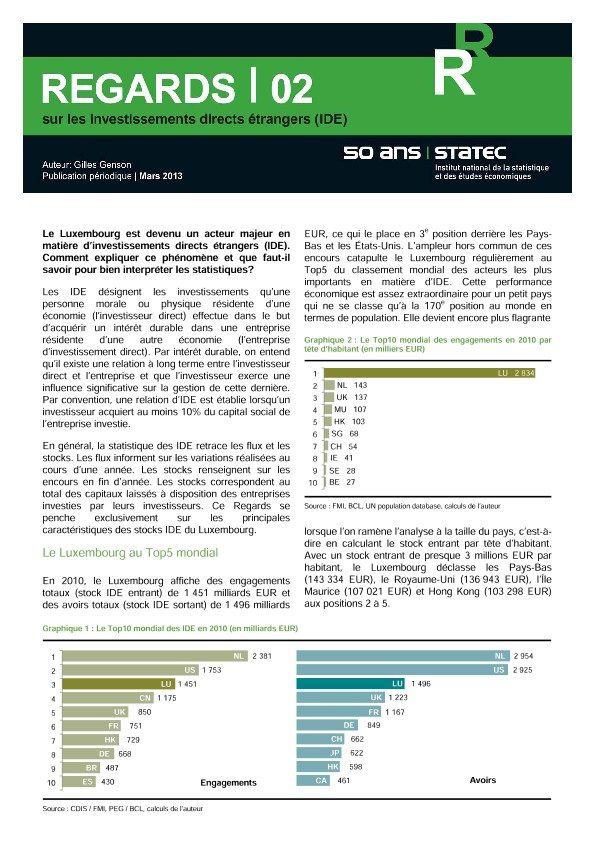
02-2013 Regards sur les Investissements Directs Etrangers (IDE)
Luxembourg has become a major player in the field of foreign direct investment (FDI). The remarkable level of its FDI stocks regularly places the country into the top5 world ranking. What explains this quite exceptional economic performance of a small country that ranks only at the 170th position in terms of world population and how to make the right interpretation of these statistics?

01-2013 Regards sur les technologies de l'information et de la communication dans les ménages
The recent ICT survey form Statec reveals that 92% of households in Luxembourg are equipped with a computer and have an Internet access at home. Most non-Internet users are in the age group of 55-74 years. 95% of the 16 - 74 age group are equipped with a mobile phone or smart-phone. Mobile access to the web is a logical consequence: 68% of Internet users access the Internet outside of work or home using a portable device (laptop, tablet, mobile phone, smartphone).
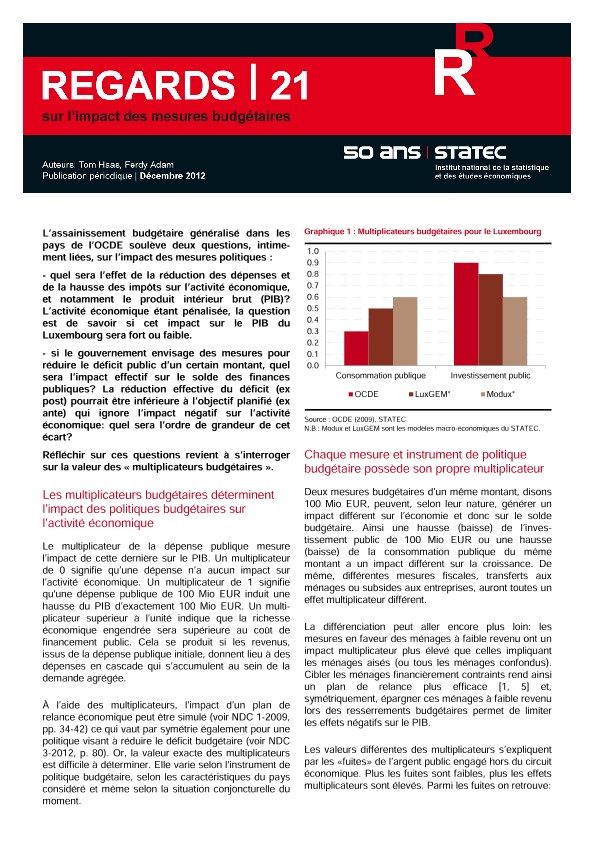
Regards sur l'impact des mesures budgétaires
Widespread fiscal consolidation in OECD countries raises two questions, tightly linked to the impact of the policy measures:
-What will be the effect of spending cuts and tax increases on economic activity, namely gross domestic product (GDP)? Economic activity being penalized, the question is whether the impact on Luxembourg GDP of will be strong or weak.
- If the government is considering measures to reduce the deficit by a certain amount, what will be the final impact on the balance of public finances? The effective (ex post) reduction of the deficit may be less than the targeted (ex ante) reduction that ignores the negative impact on economic activity: what will be the magnitude of this discrepancy?
Reflecting on these questions is trying to evaluate the importance of the so-called "fiscal multipliers".

Regards sur l'évolution de la population de la Grande Région
Statec is analysing the evolution of the population of the Greater Region which passed from 11.190.299 in 2000 to 11.413.757 in 2011, representing an increase of 2%. The population of Luxembourg increased by 18% during the same period. More than 35% of the increase of the population of the Greater Region between 2000 and 2011 is due to Luxembourg. However the population of the Grand-Duchy is representing for 4.5% of the Greater Region.

Regards sur le vieillissement au Grand-Duché
In the context of the International Day of Older Persons, celebrated annually on October 1st, STATEC looks at the demographic trends of the 65 years and older as well as at the labour market situation for people aged 55 – 64. How “seniors” are perceived and how they see society is also mentioned.

Regards sur le volume du tourisme et le comportement de voyages des résidants 2011
Tourism activity restarts in 2011; both leisure and business travel have expanded. They almost reach the levels of the years before the drop in 2010. Statec numbers reveal indeed that in 2011, 17 % of the residents of the Grand Duchy traveled for business including at least one overnight stay, compared to 11.9 % in 2010.
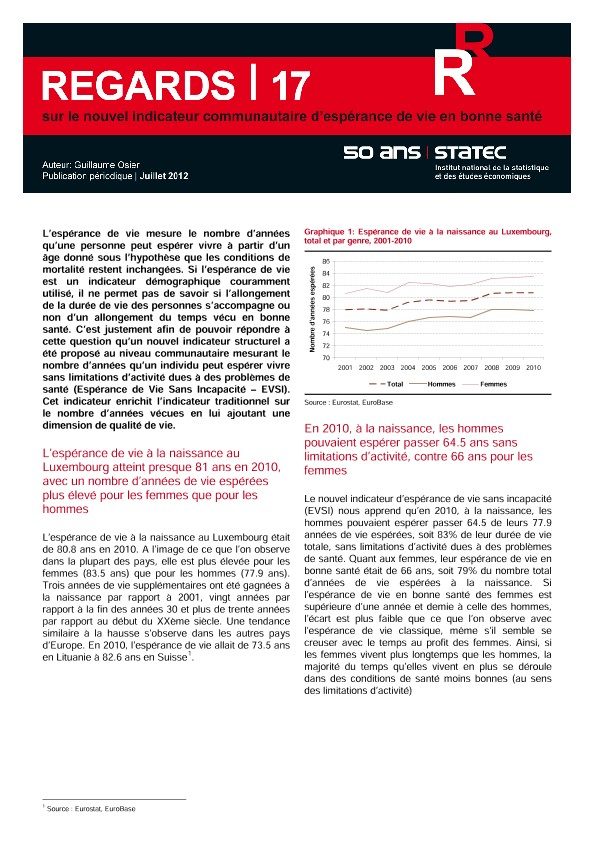
Regards sur le nouvel indicateur communautaire d'espérance de vie en bonne santé
Life expectancy measures how many years a person can expect to live from a given age assuming mortality conditions remain unchanged. If life expectancy has turned out to be a commonly used demographic indicator, it cannot answer the question whether extra years of life are spent in good or bad health conditions. That’s why a new European structural indicator has been developed measuring how many years of life a person is expected to spend in a healthy condition (Healthy Life Years - HLY). Contrary to life expectancy, which is a quantitative measure, this new indicator focuses on quality of life.

Regards sur le volume du tourisme et le comportement de voyages des résidants en 2011
After some reluctance to travel in 2010, residents of the Grand Duchy are again more likely to travel in 2011. Tourism activity restarts significantly in 2011 and almost reaches the levels of the years 2008 and 2009.

Regards sur la prise en charge des enfants par des structures de garde externes
The use of the resident population in Luxembourg of different childcare structures is different for their children less than 15 years of age. 58 % of the households declare having used a childcare system for their youngest child (between 0 and 14 years). This proportion is higher among persons of tertiary education level, as well as among persons having an average income.

Regards sur les acquisitions de la nationalité luxembourgeoise
Since the coming into force of the new Luxembourgian nationality law (1st of January 2009) until the end of 2011, 11 738 persons did acquire voluntarily the Luxembourg citizenship. This number exceeds three times the level of the three years preceding the coming into force of the law. Persons of Portuguese nationality count for a third in the total of voluntary acquisitions. 35% of the persons acquiring the citizenship were born in Luxembourg. Furthermore, 2 500 minors did automatically acquire the nationality with their parents and some 4 000 people did acquire the citizenship because one of their parents was born in Luxemburg. All in all, more than 18 000 people acquired the Luxembourg citizenship from 2009 to 2011.
Les acquisitions de la nationalité luxembourgeoise - Données complémentaires
Since the coming into force of the new Luxembourgian nationality law (1st of January 2009) until the end of 2011, 11 738 persons did acquire voluntarily the Luxembourg citizenship. This number exceeds three times the level of the three years preceding the coming into force of the law. Persons of Portuguese nationality count for a third in the total of voluntary acquisitions. 35% of the persons acquiring the citizenship were born in Luxembourg. Furthermore, 2 500 minors did automatically acquire the nationality with their parents and some 4 000 people did acquire the citizenship because one of their parents was born in Luxemburg. All in all, more than 18 000 people acquired the Luxembourg citizenship from 2009 to 2011.

Regards sur les flux migratoires
Net migration into Luxembourg is growing fast over the last few years. 20 268 people were coming to live in Luxembourg in 2011. As emigration was rather stable, net migration reached + 11 004 persons, the highest level ever for Luxembourg.
Compementary data (french, xls)
Les flux migratoires - Données complémentaires
Net migration into Luxembourg is growing fast over the last few years. 20 268 people were coming to live in Luxembourg in 2011. As emigration was rather stable, net migration reached + 11 004 persons, the highest level ever for Luxembourg.
Compementary data (french, xls)

Regards sur les tâches liées aux ménages et aux enfants
What is the average time spent on domestic duties and on duties linked to children in Luxembourg? How are these tasks shared between men and women? A woman spends on average 19 hours a week on domestic duties, a man 8. For a woman with children, this average is even 24 hours a week. Domestic duties include preparing meals, shopping, washing, tidying, cleaning, etc. Parents spend 28 hours a week on average to take care of their child(ren), with a strong difference according to sex: 35 hours for women and 21 for men. In this «parental time», the most important elements are “social activities” (playing games, conversations, etc.), which count for more than 12 hours a week, and the “domestic” time linked to the children (dressing them, washing them, feeding them, etc.) taking up about 10 hours a week. The time dedicated on average by the parents to accompany their children with their school duties takes less than three hours a week.

Regards sur les accidents causés par la vitesse
33 people died in road accidents and 317 were seriously injured in 2011 in Luxembourg. Among the common causes of road accidents, over speeding was the most frequent one (28%), followed by the violation of the right of way (16%) and the non respect of the safety distance between cars (10%). Mostly half of the fatal accidents and two of three accidents with seriously injured were due to over speeding.
Regards sur le halo du chômage
The unemployment rate as defined by International Labour Office (ILO) has been 5.1% in Luxembourg in 2011. Taking into account the potential labor force, the unemployment rate fell to 10.0%. The potential labor force contains inactive people who are not considered unemployed according to ILO, but which nevertheless retain a link with the labor market. Moreover there are about 3 800 underemployed workers in Lxuembourg. These are part-time workers who wish to work more. Underemployment and the potential labor force constitute the halo of unemployment, a gray area situated between unemployment and inactivity and between unemployment and employment.
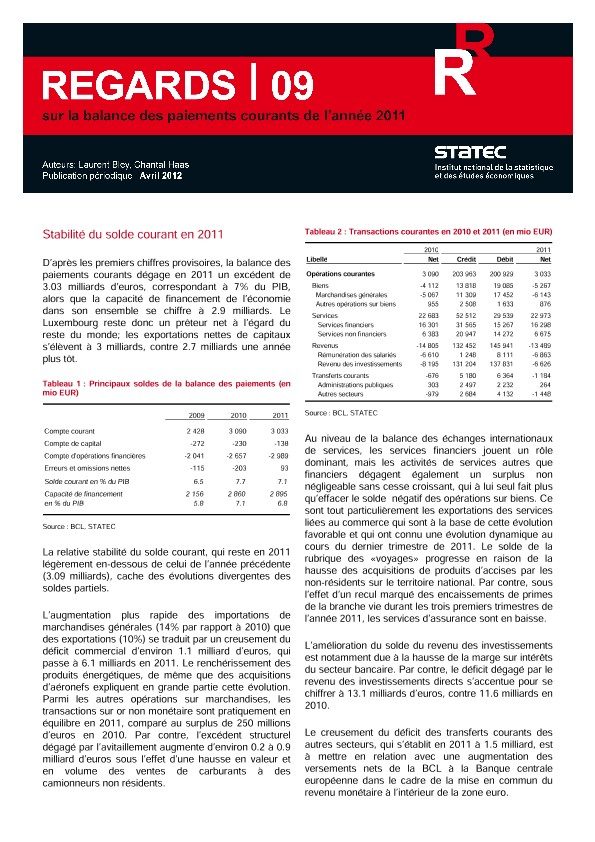
Regards sur la balance des paiements courants de l’année 2011
The current balance remains stable at a high level of more than 3 billion euros. Financial services increase despite tensions on stock exchange due to the sovereign debt crisis in Europe. Furthermore, activity related to new information and communication technologies (NICT) remains dynamic and cross border e-commerce of resident households continues to grow, especially concerning services.

08-2012 Regards sur la flexibilité des heures de travail et le travail à domicile
In this publication, Statec studies two aspects of working conditions that can have an important impact on family life: the flexibility of the working hours and the work performed at home, and in particular teleworking. 3/4 of the wage earners do not benefit from any form of flexible working time arrangements decided by them. For 2/3 of these workers however, it is generally possible to modify their working hours for family reasons.

07-2012 Regards sur les politiques de l'emploi
In 2010, Luxembourg has spent some 514 millions of Euros for labour market policies. This corresponds to 1.2 of the GDP. From 2007 to 2010, these expenses have increased by more than 46%, due to a deterioration of the labour. Among these expenses, 33% have been spent on active policies, 63% on passive policies and 4% on labour market services. Among the active measures, employment incentives play a prominent role, with 75% of the expenses.

06-2012 Regards sur les prix des appartements
Between 2007 and 2011, apartment prices raise more in Luxembourg than in the Euro zone as a whole. Nevertheless, some countries like Belgium and France display price trends very similar to those observed in Luxembourg. In addition, changes in property prices in Luxembourg are strongly correlated with economic growth.

05-2012 Regards sur l'impact de la situation familiales sur le degré d'occupation
On the occasion of the international women’s day, celebrated every year on March 8th, STATEC focuses on the impact of the family situation on part-time occupation and the absence of a paid activity. Part-time job concern almost exclusively women. In the age group from 20 to 49 years, 92 % of the persons working part-time are women. Among these, more than 70 % have chosen to do so for family reasons. Among the mothers who don't work (31 %), 3/4 declare that they made this choice for family reasons. 98 % of all persons who chose to work only part time or not at all in order to be able to take care of their children are women.
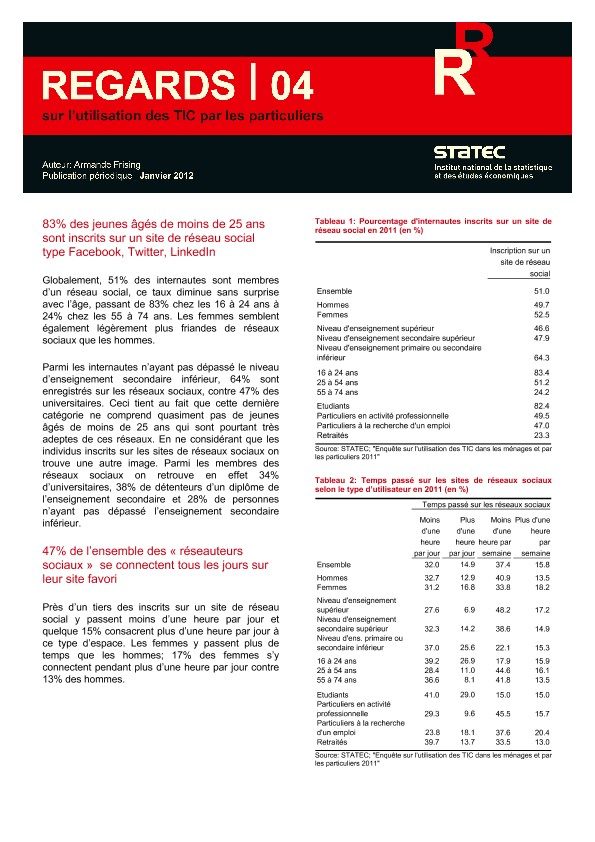
04-2012 Regards sur l'utilisation des TIC par les particuliers
Globally, 51% of internet users are registered on a social networking website like Facebook, Twitter, Linkedln and 47% log in every day, mainly to find lost friends. About a quarter of the EU-27 population have never used the internet. This proportion is 8% in Luxembourg, 14% in Belgium, 16% in Germany and 18% in France. 55% of young people aged under 25 have already downloaded cultural content illegally.

03-2012 Regards sur le travail intérimaire
In 2010, 6878 workers had been employed by temporary work agencies in Luxembourg. This corresponds to 1.6% of total employment. The main users of agency work have been the manufacturing and construction sectors: they have employed more than half of all the agency workers. The typical agency workers are men residing from France and between 25 and 34 old.

02-2012 Regards sur les bâtiments achevés
Statec has published the most recent results of the « completed buildings and dwellings » survey. From 2006 to 2008, the number of new dwellings increased strongly : 2 266 dwellings in 2006, 3 023 in 2007 and 4 444 in 2008. In that year, the number of dwellings exceeded – for the first time in 40 years - the peaks of the years 1974-1976 and 1993. This dynamic construction activity was stopped by the economic downturn of 2009 (3 740 dwellings completed in that year). Recently, 70% of the total of the completed dwellings are apartments. 60% of the total of dwellings completed between 1992 and 2009 are located in the capital (the town of Luxembourg) and in the cantons of Luxembourg-countryside and Esch-sur-Alzette. The living space in single-family residences and in apartments has an upward trend. The largest single-family residences are located in the communes bordering the capital.

01-2012 Regards sur le niveau de vie des ménages
This new publication focuses on the standard of living in Luxembourg. Obviously, GDP (Gross Domestic Product) per inhabitant is a particularly biased indicator of the Luxembourg standard of living. Gross National Income (GNI) is often considered to be a better indicator. In short, GNI is GDP less compensation of employees (for the Luxembourg case, the compensation of cross-border workers) and income payable to the rest of the world. In fact, gross household income and household consumption are the most adequate national accounts aggregates to measure standards of living. The Luxembourg GDP per capita is 150% higher than the euro zone average. For household income and household consumption per inhabitant in Luxembourg, the difference is reduced to about +45% in comparison to the euro zone. The slight increase of household income in 2009 is largely due to social transfers.


Regards 21-2011-depenses-consommation
This publication presents the main results from the wave 2009 of the Household Budget Survey (HBS). The survey has been conducted by the Statec continuously since 2003 over a representative sample of private households living in the national territory. The aim is to collect detailed information on the level and the structure of household consumption expenditure. The sample for the 2009 wave is made up of the data which had been collected in 2008, 2009 and 2010.


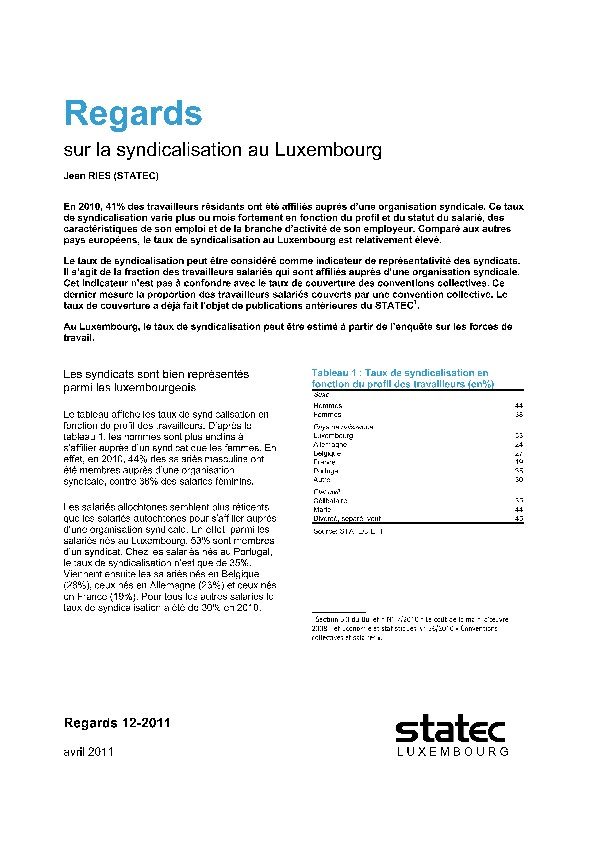


9-2011 Regards sur les 65 et plus
This publication puts a focus on the persons aged 65 and more living in Luxembourg. The number of people in this age-class is fast-growing, but - in relative terms - the proportion of people aged 65 and more in Luxembourg is relatively low compared to other European countries. .

N° 8/2011 Regards sur le niveau du coût de la main-d'oeuvre et la durée de travail dans la Grande Région

N° 7/2011 Regards sur les avantages en nature des salariés
Income in kind refers to goods and services provided at reduced price by employers to their employees for private use (company car, luncheon vouchers…). On the basis of the EU-SILC 2009 data, the present publication aims at analyzing the importance of income in kind as part of the total employee’s income.


N° 4/2011 Regards sur la diversité des nationalités au sein des entreprises du Luxembourg
Diversity within companies is a subject of much debated, since there is no unique and shared definition. The concept here is approximated from data on nationality of workers employed by companies in Luxembourg. Do Companies represent the variety of nationalities present in Luxembourg and which compose the workforce? It appears that this variety is restricted to a few very specific sectors of the economy.


N° 2/2011 Regards sur le niveau du coût de la main-d’œuvre et la durée de travail au Luxembourg et en Europe


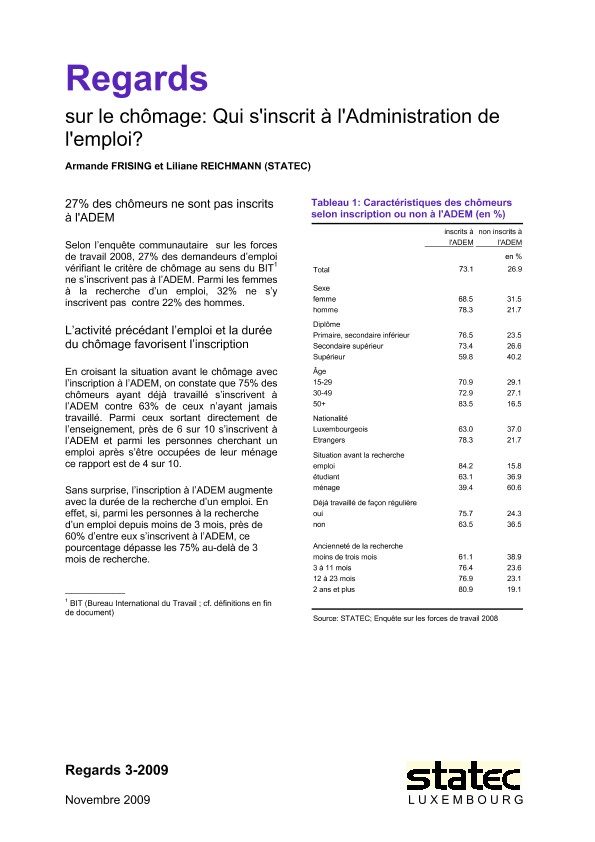


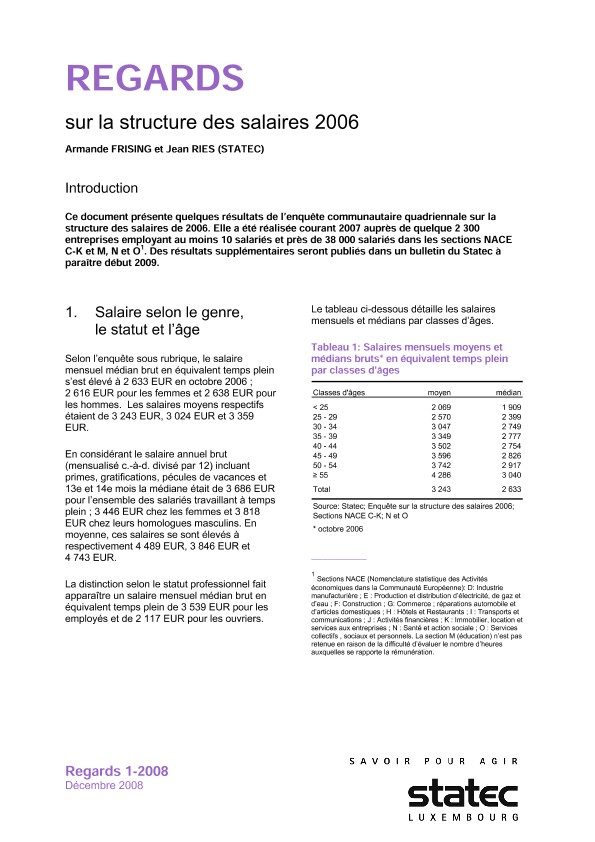
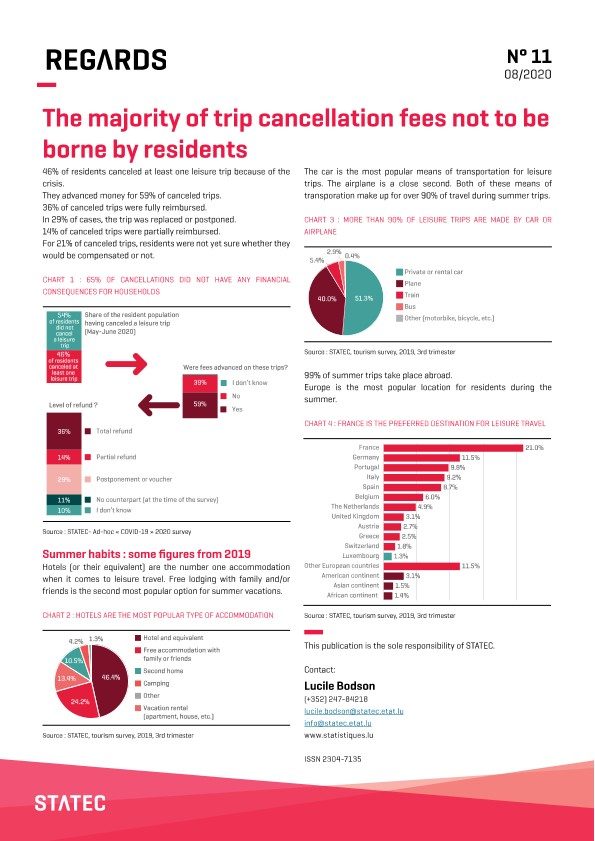
N°11/2020 - The majority of trip cancelation fees not to be borne by residents

20-16 Regards sur les gains de revenu liés à la baisse des prix du pétrole
Oversupply and sharply falling oil prices have been seen over the last three years, with prices starting to stabilise at low levels since the beginning of 2016. From 2013 onwards households profited from falling oil prices, generating cumulated savings of around 140 mio EUR through to 2015. This amounts to (per household) 90 euro in 2013 and an estimated 330 euro in 2015. Comparing aggregate savings in 2015 with total household consumption, the gain amounts to 0.5% of disposable income.


18-16 Regards sur les voyages de loisirs en 2015
Over the last 4 years, the leisure tourism activity remains stable at a high level: 83% of residents aged 15 and more did at least one leisure trip, including at least one night, in 2015. France and Germany are still the favorite destinations. Overall, nearly a journey in three (31%) is considered as relaxing trip without special activities. A trip in four (24%) is for the visiting of family or friends and one in five (19%) is dedicated to culture. The most often cited reasons for not traveling are health problems (31%).
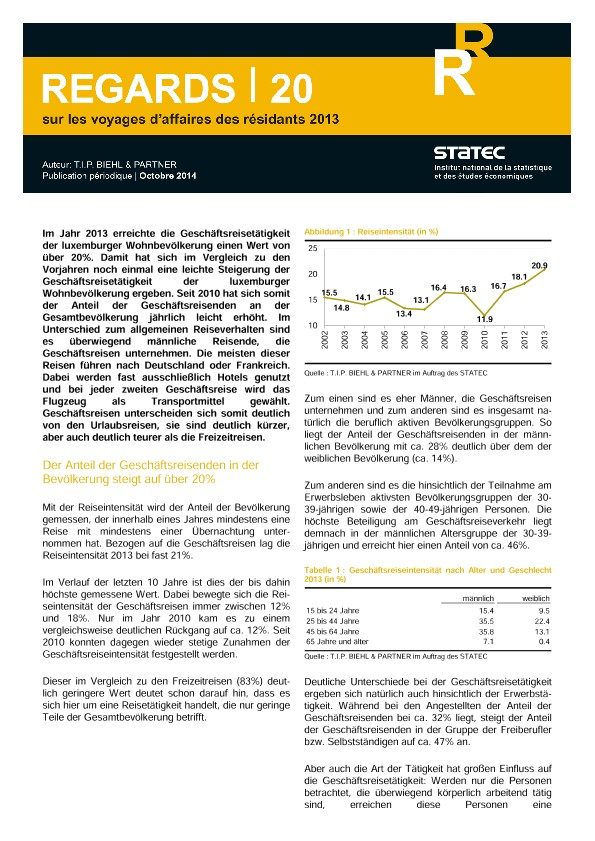
20-2014 Regards sur les voyages d'affaires des résidents 2013
In 2013, 20% of the resident population made a least one business trip with at least one overnight stay. After a slight decline in 2010, business trips restarted in 2011, reaching in 2013 the highest level ever. Business trips are mainly done by men, the main destination is situated in Germany or France. The business people are mainly accommodating in hotels, and for one of two business trips, they travel by plain.

11-2014 Regards sur les voyages de loisirs des résidents 2013
After some reluctance to travel in 2010, the positive development of tourism activity holds on. In 2013 83% of the residents in Luxemburg have realised at least one overnight trip for personal reasons. The main reason for travelling in summertime was leisure or recreation at seaside. Reasons for not travelling were mainly due to health problems.

Regards sur les voyages d'affaires des résidants 2012
In 2012, the business travel intensity is 18.1%. Nearly one out of five residents, aged 15 and more, has made at least one business trip with at least one overnight stay. After a slight decline in 2010, business trips restart in 2011, reaching in 2012 the highest level of the past 10 years.

Regards sur le volume du tourisme et le comportement de voyages des résidants en 2012
In 2012, the travel intensity of the residents of the Grand-Duchy remained quasi stable. After an intense decline in 2010, she found a positive trend over the past two years. In 2012, 81% of the population aged at least 15 years have taken at least one trip.

Regards sur le volume du tourisme et le comportement de voyages des résidants 2011 (deutsche Fassung)
Tourism activity restarts in 2011; both leisure and business travel have expanded. They almost reach the levels of the years before the drop in 2010. Statec numbers reveal indeed that in 2011, 17 % of the residents of the Grand Duchy traveled for business including at least one overnight stay, compared to 11.9 % in 2010.

Regards sur le volume du tourisme et le comportement de voyages des résidants en 2011
After some reluctance to travel in 2010, residents of the Grand Duchy are again more likely to travel in 2011. Tourism activity restarts significantly in 2011 and almost reaches the levels of the years 2008 and 2009.